(Prefer to listen? Tap here)
Loving with Open Hands
There is a time for rocking babies to sleep and filling the kitchen table with crafts and science experiments. And then, quietly, our place in the circle begins to shift. In this episode, I reflect on how the ache we feel isn’t from love fading, but from expecting it to look the same in every chapter—and how we can learn to love with open hands.
I love Elton John’s song, The Circle of Life. I’ve certainly noticed that life seems to move in a steady rhythm. Homes fill with noise and toys and schedules and needs and longings—and then, almost without warning, they begin to empty again. Children grow up. Parents age. Roles change. What once needed constant tending suddenly asks for a different kind of presence altogether.
Years fly by. The cuddly infant becomes a toddler learning to say no, followed by the child with strong opinions and then the teenager with a bedroom door that closes more often than it used to. Those caring for aging parents recognize it in the quiet role reversals—when the one who once carried you begins to lean on you instead.
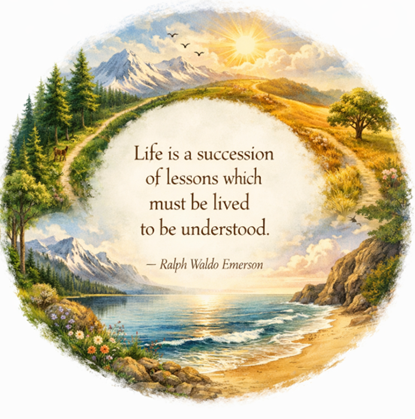
It’s impossible to freeze time and hold one moment in place. We may fuss or get sad about it, but life keeps offering us lessons about how to move with change—to loosen our grip and open ourselves to what’s next.
I’ve lived this from several places in the circle—as a grandchild, a parent, and now as a grandparent. When I was forty-five—which seems so young now—my attention and energy were naturally directed toward my immediate family—a husband and three sons. I didn’t see my paternal grandmother often. Distance played a role—Sacramento to Los Angeles, later Sacramento to San Luis Obispo—and life was full in the way midlife often is.
One weekend, knowing Grandma’s health was failing, my father flew out from Louisiana to visit her. When I realized this would be a rare chance to see them both, I left my busy family life and drove down to her home, grateful that it would also give me time with my favorite aunt, some cousins, and my dad. That visit became an unexpected gift.
I still remember her crystal blue eyes, red-rouged cheeks, and the dentures that never quite fit, leaving her mouth a little crooked. Even in her final weeks, when she could no longer leave her home for daily errands, she kept her lipstick fresh and her grey hair curled in soft waves with pin curls above her ears. Her posture was stooped after almost ninety years on the planet. Her legs, once her pride and joy, carried her slowly with the help of a walker.
I slept on the extra bed in her room for two nights. I slept lightly, the way you do when you’ve just brought home a baby—attentive to confusion and restlessness. In the mornings we sat at the yellow Formica kitchen table, the same one where I had once sat as a small child.
She would reach for my hand and say, “I love you.” And, then, with a puzzled look, say, “I’m sorry, what was your name again?” I would tell her.
She would ask about my children—how many, their names, their ages. I would answer. And then we would begin again. “I love you.”
We repeated this gentle litany many times over those two days. Our time together held no busyness or deadlines—just presence—clear, unguarded, sacred. Names slipped away. History blurred. A few weeks later, I attended her funeral.
My grandmother had a reputation for being difficult. Life had not been kind to her. She was a survivor and had endured more than she ever spoke of. But those final days softened something in both of us. My memory of her changed. What lingered was not sharpness or struggle, but the warmth of her hand in mine and the steady rhythm of “I love you.”
At forty-five, I hadn’t yet lived enough life to see the whole circle. I see things now that it was impossible to recognize when I was in the thick of parenting—never mind when I was a teenager still trying to figure out life.
I became a first-time grandparent twenty-two years ago. It was pure joy. I felt again the soft weight of a sleeping baby on my chest, the way time slowed when I rocked him, the wonder of watching my son grow into fatherhood with such tenderness and competence.
I loved each of my grandbabies. My second and third came as a matched set of identical twin boys—quite an experience and double the fun. “My fourth grandson arrived as an unplanned surprise from my oldest son, who didn’t live close by. He, too, is now navigating the letting go that comes with teenagers.
I loved crawling on the floor, playing peek-a-boo, and reading the same book for the hundredth time. I looked forward to babysitting and silly games and small hands wrapped around my fingers. I created a crafting bin to bring when it was my turn to babysit.
Crafting and stories gave way to bleachers and folding chairs—Little League games, soccer and basketball, school performances—applause offered from a few rows back as children began stepping into their own unfolding lives.
And slowly, sometimes almost imperceptibly, came another season—the one where I began to move further from the center. Parents’ schedules filled. Divorce and complexity reshaped access and proximity in ways no one quite plans for. Attention continued its natural forward motion. Like many grandparents who once stood close to the center of things, I noticed myself gently—and sometimes painfully—moving toward the edges.
Nothing and no one is wrong. It’s simply how life moves—one empty nest and then another. Trying to hold on too tightly can actually create the very distance we fear. The ache doesn’t come from love fading. It comes from expecting it to look the same in every chapter. Still, the changes can sting. We feel it when teenagers begin to live their own lives—and again when those teenagers grow up and create families of their own.
We cannot control outcomes, but we can keep the door to our hearts open for when those we love show up. I haven’t seen my three local grandsons in several years because of a bitter divorce. My youngest grandson lives out of state. A rhythm of yearly birthday visits quietly changed when his parents’ marriage ended. My grandsons are now young men—standing on the threshold of their own adult becoming. Love remains—even when access changes.
Almost four years ago, I was blessed with a granddaughter. After years of sons and grandsons, having a girl in my life has been an unexpected delight — a different kind of energy, a different kind of conversation. She arrived in my life just before her eleventh birthday—fully formed, bright, funny, eager for time together. We had a couple of sweet years when she loved spending time with me. Now, at fourteen, she is wonderfully immersed in friends and adolescence. I still feel close to her and always will, even as we both continue to grow and change.
Watching friends navigate similar changes with their own grandchildren led me back to that weekend with my grandmother. At forty-five, I was living fully in the season of forward-moving attention—pouring love into my own children, my work, and daily responsibilities. I could not yet feel what it might mean someday to live more in the margins of younger lives.
Now I can. Perhaps this is one of the quiet freedoms the perspective of aging offers—the freedom to bless the seasons rather than resist them. There is a time for rocking babies and crawling on the floor. There is a time for bleachers and folding chairs. And there comes a time for loving a little farther from the center of the picture.
None of these seasons lasts forever. None can be reclaimed once it passes. But each carries its own holiness. Each asks a different posture of love.
When I think back to my grandmother’s blue eyes and her steady “I love you,” I understand something now that I didn’t then. Even as names faded and roles reversed, love remained. It simply changed shape.
If we are willing to meet the season we are in—rather than the one we wish we were still living—there is a surprising tenderness just waiting there.