
(Prefer to listen? Tap here)
Taking the Helm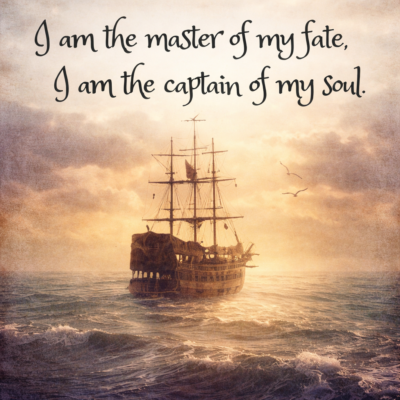
“Everything can be taken from a man but one thing: the last of the human freedoms—to choose one’s attitude in any given set of circumstances, to choose one’s own way.” Viktor Frankl
I want to recognize Presidents Day this week. I began by looking into how the holiday itself came to be. The history was interesting, but it wasn’t what held my attention. What lingered instead was the idea of presidential leadership—and that led me back to research I had done years ago into the childhoods of some of our presidents. I had been struck by the hardships many of them endured. Long before they became figures in textbooks or faces on monuments, they were children encountering events they did not choose. Their greatness was forged long before their power—in childhood loss, longing, responsibility, imagination. Not in marble halls, but in kitchens, fields, grief, loneliness, and curiosity.
A boy named George Washington lost his father at age eleven. His older half-brother Lawrence became his model of refinement and military honor. Without the funds to attend university in England as his brothers had, young Washington became a surveyor in the Virginia wilderness—a teenager mapping vast, untamed land alone, responsible for measuring boundaries. When Lawrence died years later, Washington lost not only a brother but the mentor who had shaped his early ambitions.
Thomas Jefferson’s childhood was very different. His father died when he was 14, but unlike Washington, he grew up in relative privilege, surrounded by books. He was intellectually hungry—studying Greek, Latin, philosophy—and played the violin obsessively. At a young age he inherited land and slaves, along with responsibilities and contradictions he would wrestle with for the rest of his life.
A frontier child named Abraham Lincoln buried his mother at nine and educated himself by candlelight in a one-room cabin. His stepmother encouraged his reading, and he read constantly—Shakespeare, the Bible, law books. He absorbed sorrow early. Many scholars believe this exposure to hardship, loss, and manual labor shaped his empathy and moral seriousness. The boy who split wood became the man who held a fractured nation together.
Theodore Roosevelt struggled with severe asthma and, encouraged by his father, resolved to build strength into a frail body. From that weak child gasping for breath grew a lifelong discipline of resilience—and the passion for vigor, reform, and bold action that would later define him.
Different childhoods. Different temperaments. Different soil. Different fruit. And yet, at some point, each of these boys grew into men who learned to respond constructively and became great leaders. They did not control the deaths of parents, the illnesses of their bodies, or the circumstances of their birth. Over time, loss became teacher, limitation became discipline, longing became fuel. The childhood wound didn’t simply disappear. It was absorbed, reshaped, and became the ground from which greatness grew.
History also reminds us that hardship alone does not produce greatness or give rise to evil. It creates vulnerability. What happens next hinges on temperament, environment, relationships, and the stories mirrored back to us. Ultimately, it depends upon choice. Suffering can deepen compassion, but it can also ferment into bitterness. The same early wounds that cultivate empathy in one life can distort another. Adolf Hitler’s childhood is a chilling reminder of that possibility. In some lives, wounds harden into grievance and, when combined with unchecked power, become destructive.
Years ago, one of my favorite teachers, Jack Canfield, offered a simple equation that has stayed with me: Event+Response=Outcome. The outcome is shaped in that narrow but powerful space between what happens and what we make it mean. By the time I encountered Jack’s formula, I had already spent decades exploring that relationship between events and interpretation. There was something clarifying about seeing it distilled so simply. We can rarely, if ever, control the event. The only part of the equation that truly belongs to us is our response—and even that becomes ours only when we are aware enough to see the choice before us.
Suffering is the raw material—it is not the finished product. What appears to make the difference is not the event itself, but the story constructed around it. Who models resilience? Who encourages responsibility rather than grievance? Who helps a child understand that pain, while real, does not have to become identity? What role does a loving or a cruel parent play? Do we become stewards of our story or prisoners of it? Do we let early pain define us or refine us? Every one of us has a childhood story. Every one of us stands at that fork of bitterness or responsibility—not once, but again and again—we face a moment of choice.
For me, realizing that I had a say in the outcome unfolded slowly. It did not arrive in a single revelation. For much of my childhood, my life felt more like an arcade game—and I was not holding the joystick. Moving multiple times, feeling uprooted, parents divorcing, unexpected pregnancy, a challenging marriage—ricocheting from one circumstance to another. I sometimes think of those years as my pinball chapters—movement without authorship. I wasn’t without intention, but I was largely reactive. For years I felt like life was happening to me. It wasn’t until I encountered a body of work that challenged me to examine my interpretations that I began to see how much of my experience was shaped not just by events, but by the meaning I made of them.
I began paying closer attention and could see how two people experiencing the same disappointments could emerge with entirely different outcomes—not because the event differed, but because the response did. We are subject to loss, illness, and unexpected turns. We do not command those events. But we are not powerless. Our power lies in how we respond.
For years, when talking about this shift—from life happening to us to life being something we can work with, experiment with, and help shape—I have used the image of a baby discovering a hand for the first time. I watched it unfold in my own children, and later in my grandchildren. If you are paying attention, there is a moment when flailing becomes fascination. The child turns the tiny hand over and over, studying it, flexing small fingers, astonished that this marvelous thing at the end of an arm is somehow connected and moving with intention. The foreign object that may once have scratched and grabbed and bonked a tender face is suddenly recognized as one’s own.
Recently, I came across a video that captured that moment perfectly—a baby girl staring at her hand with wonder, reaching out to grab her father’s nose and beard, then pulling back to examine again this astonishing discovery. It felt almost magical to witness on screen something I had described so many times in conversation. She is not ready to grab a pencil and write an essay, but she has crossed a threshold. The hand that once moved unpredictably now belongs to her. In time, those same hands will hold a spoon, gather food, reach for comfort, and eventually make decisions far beyond the crib. If you’d like to see it for yourself, you can watch it here.
More than a century ago, the poet William Ernest Henley wrote, “I am the master of my fate, I am the captain of my soul.” I have always loved that image—not because it promises calm seas, but because it places me at the helm—consciously in charge—steering rather than drifting.
The baby studying her hand does not yet know about helms or rough seas. She only knows that something once startling now belongs to her. It moves when she moves. It reaches when she reaches.
Perhaps that is where leadership begins—not in commanding others, but in recognizing our own power. In noticing the space between event and response. In discovering that something truly belongs to us. Not the storm. Not the sea. But our hand upon the helm and our freedom to choose our way.