(Prefer to listen? Tap here)
Welcoming the Whole Enchilada
Why is it often easier to enjoy what a culture creates than to welcome the people themselves? As I reflect during Black History Month, I share some honest thoughts about tribal instincts, widening our circles, and a quiet conviction that love keeps refusing to give fear the final word.
This month is Black History Month—a time to honor the contributions and voices of Black people, not only those we know from history, though they matter deeply, but living voices—fresh and observant, unafraid to hold up a mirror with humor instead of a hammer.
One of those voices I particularly enjoy belongs to Josh Johnson, a stand-up comedian and writer for The Daily Show. He’s young. He’s Black. He’s sharp in that effortless way that makes you laugh before you realize you’ve been gently led somewhere uncomfortable. He tells stories about awkward moments and social misfires—the kinds of universal embarrassments that remind us how human we all are. Much of his humor has nothing to do with race at all. But every so often, he widens the lens.
Recently he did a bit about the outrage surrounding Bad Bunny performing at the Super Bowl in Spanish. (Click here to listen.) Johnson mimics the indignation of someone sitting with a bowl of chips and guacamole, tacos, and a margarita, saying, “I want my Spanish in my mouth, not in my ears.” The joke lands because it exposes the contradiction. We love the food. We love the rhythm. We love the art. But for some, hearing Spanish at the Super Bowl—one of our most American stages—stirs discomfort.
The tension is real. Johnson helps us laugh about it, and his humor may help us bridge the gap. He gently points out how we love the “stuff” another culture creates yet remain uneasy about the people who created it.
I grew up and still live in white suburbia. Even during the years I lived in the Deep South, my schools and neighborhoods were segregated. My exposure to Black life was limited and closely resembled scenes from the movie The Help—a world of clear social lines and unspoken rules. I remember identifying with the young woman in that story who sensed the injustice around her but struggled to know what to do with it. I still struggle.
These days, most of my friendships are with people who look and live a lot like I do. I suppose it’s that old adage about “birds of a feather,” and like most adages, it carries a grain of truth. I would be the first to admit that I am culturally naïve in many ways. Even when I have traveled, it has been mostly within familiar Western European settings—not places that stretched me culturally in significant ways. But I am willing to learn. I am willing to welcome different colors, voices, accents, and preferences.
We live in a world stitched together—economically, culturally, digitally. Our food, our music, our art are already a patchwork quilt. This month we celebrate how profoundly America has been shaped by Black creativity and resilience. The dishes we enjoy from the South—gumbo, fried chicken, grits, and sweet potato pie—carry the imprint of enslaved Africans and their descendants, people whose humanity was denied even as their gifts were embraced. Jazz, born in New Orleans, grew from suffering intertwined with resilience. We celebrate these gifts enthusiastically.
Yet loving the music and the meal has not always meant fully welcoming the people behind them. This pattern is not uniquely American. Across the globe, societies have absorbed the beauty, labor, and artistry of marginalized groups while resisting their presence or power. We readily consume what others create, yet too often hesitate to fully honor and include the creators. And when fellow human beings are treated as problems instead of neighbors, something in me aches.
I have seen, over decades, how progress is born of struggle. I remember the sit-ins for equal rights and the Vietnam War protests—seasons of tension and upheaval that, in time, reshaped our nation.
I keep coming back to the question of why it’s often easier for me—and perhaps for others—to love what a culture produces than to truly welcome the people themselves. It is one thing to enjoy the music, the food, the style; it is another to sit across from someone whose language or customs are unfamiliar and still feel at ease. That kind of encounter requires stretching—an openness to uncertainty and a willingness to be changed by what we do not yet understand. It can feel unsettling.
That tension makes me think of a film I truly enjoyed. Helen Mirren stars in The Hundred-Foot Journey, where two culinary traditions—French and Indian—face off across a street only a hundred feet wide, yet worlds apart in suspicion and pride. Through proximity, shared meals, and a gradual recognition of common ground, the distance begins to close—each tradition ultimately enriching the other. The act of preparing and sharing a meal becomes a bridge to understanding.
And yet, I realize something else about myself. I would welcome those kinds of conversations. I would welcome the chance to sit across from someone whose language or customs stretch me. But at this stage of my life, those opportunities do not often land at my table. I no longer travel widely. My daily circles are familiar ones. Many of us live this way, staying within familiar routines and trusted circles. It is not usually malice that keeps us there. It is habit—and habit, over time, can quietly reinforce the sense of “other.”
Perhaps that is why art, film, music, and even comedy matter so much. They bring faces and voices into our living rooms that might not otherwise sit across from us. They give us a way to encounter difference without immediately retreating from it. They do not replace real relationships, but they can remind us that the person behind the language, the music, the meal, is not a label but a human being.
I am still learning how to widen my circle—still learning how to appreciate difference without surrendering values that matter deeply to me. Still listening to voices like Josh Johnson’s that make me laugh and then gently challenge me to look closer. Perhaps that is where change takes root—choosing, again and again, to see the full humanity of those whose language, skin, or customs differ from my own.
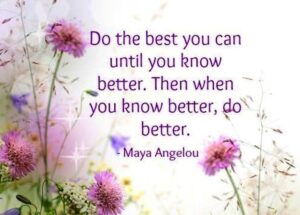
As Maya Angelou reminds us, when we know better, we do better. I hold a stubborn belief that love is patient and kind. Fear burns hot and fast, but love is steady and enduring. Yet love has outlasted the loudest voices of division and keeps refusing to give fear the final word.