Prefer to listen? Click here.
Make Room for Play
Last Friday morning, my friend a few houses down called to ask if I had a pair of rubber gloves she could borrow. She and another friend were making pepper jelly and wanted to avoid burning their hands with jalapeño juice.
I found some gloves buried in the broom closet and offered to deliver them. She sweetened my offer with the promise of a croissant. I grabbed the gloves and headed out.
I walked into a kitchen filled with laughter. Peppers were being chopped, blenders buzzed, recipes were checked and rechecked, and ingredients stood lined up, ready to go. It was poetry in motion—or maybe more like a rock concert. I joined in.
I’ve made jams before, but never pepper jelly, even though I love it. A phone call, a croissant, and a pair of borrowed gloves turned into an unexpected lesson in making delicious pepper jelly using those old-fashioned canning jars with their familiar metal lids.
As I walked home, I realized we’d done more than learn to make pepper jelly. We had been playing in our grown-up version of a sandbox—laughing, working side by side in the kitchen. I loved that morning. The jelly was almost beside the point. The real gift was the joy of learning, creating, and spending time with friends.
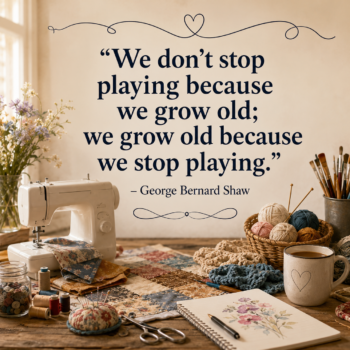
To me, creating and playing feel the same. When someone asks what I’m doing, my answer is often, “I’m playing.” Then I tell them I’ve been sewing, crocheting, writing, or trying a new recipe. Give me colorful cotton prints, my sewing machine, an idea, and I’m perfectly content. Lately it’s making tote bags, insulated casserole carriers, dolls, stuffed animals, and whatever else happens to capture my imagination. Add yarn, crochet hooks, embroidery thread, or a basket of fiberfill stuffing, and I can happily stay in my creative zone for hours.
My oldest son’s play time is tending his garden. For my middle son, it’s time spent on his pottery wheel covered with clay. For others, it may be restoring an old chair, solving a crossword puzzle, arranging flowers, playing the piano, or keeping a journal.
One of the unexpected gifts of retirement is having more time to play. But we don’t need to wait until we’re retired to nurture our creativity. I’m encouraged to see that younger generations are rediscovering many of the old home-and-hearth skills. My Facebook feed is bursting with quilting tutorials, crochet projects, pottery classes, sourdough recipes, writing tips, gardening, canning, and every imaginable craft. I wondered what pigeonhole the algorithms had placed me in. Did they think I was determined to try every craft ever invented?
I’ll admit it—I could easily be pegged as a multi-crafter. My interests often far outpace my abilities, so I’m sure clicking on all those videos made me a target. But I also wondered if something else was going on. My curiosity was piqued, so I started digging. It turns out my hunch was right. Sewing, quilting, knitting, embroidery, pottery, woodworking, canning, baking, crocheting, and even needlepoint are all experiencing a revival.
This renaissance of traditional skills has a new twist. There was a time when every family had someone who knew how to sew on a button, bake bread, or can peaches. Today, for many of us, that teacher is YouTube. I’ve lost count of the things I’ve learned from YouTube. That’s where I learned to nurture a sourdough starter, make dolls, paint their faces, sew on their hair, and tackle countless projects I never would have attempted years ago. Today’s teachers—and a whole lot of grandmas—may live halfway around the world. They generously share their knowledge one video at a time. Almost every craft has an online tutorial and a community to go with it. The classroom has changed, but the satisfaction of creating something hasn’t.
We still delight in learning something new and sharing it with someone else. Technology can teach us how to make something, but it can’t replace the joy of making it together. I could have learned to make pepper jelly on YouTube. It wouldn’t have been nearly as much fun. Most of my creating is done alone, and that’s okay. However, last Friday reminded me of how much fun it is to play together.
Making things has almost always brought people together. Friends gather to quilt. Gardeners swap cuttings and seeds. Knitters meet in coffee shops. Families spend afternoons canning peaches or making holiday cookies. Pottery studios buzz with conversation while wheels spin. Even online crafting communities are less about showing off finished projects than encouraging one another to keep creating.
Researchers say we are rediscovering these activities because they lower stress, encourage mindfulness, and provide a genuine sense of accomplishment. Working with our hands lowers cortisol, the body’s primary stress hormone, and gives our minds a chance to settle. One psychologist compared an hour of creative activity to the calming effect of an anti-anxiety medication—not because working with our hands cures anxiety, but because it gently shifts our attention away from mental chatter.
We can’t be worrying about tomorrow while trying to stitch a straight seam. When we’re crocheting, our hands find a rhythm that quiets the endless list of things still waiting to be done. Digging in the dirt or pulling weeds grounds us in the moment. Our concerns don’t disappear, but they fade for a while.
A conversation I had last week with a friend reinforced the benefits of play. She is recovering from a stroke. One of the challenges she faces is regaining strength and coordination in her left hand. We made plans to spend an afternoon together this week—not with therapy worksheets, but with yarn and crochet hooks.
She hasn’t crocheted in years, so I’m going to help her rediscover it. The crocheting will strengthen her hand and encourage new neural pathways, but I suspect something even more important will happen. We’ll laugh. We’ll solve little problems together. We’ll play with her dog. And we’ll crochet. By the end of the afternoon, she won’t just have exercised her hand. She’ll have created something beautiful.
Looking back on last Friday, I realized the morning’s pepper jelly and the afternoon’s promise of relearning crochet were really about the same thing. There’s a special kind of joy in creating something together. I enjoy playing on my own, but every now and then it’s fun to join someone else in their sandbox.
We’ve always recognized golf courses, tennis courts, and pickleball courts as playgrounds for grown-ups. I’d argue that kitchens, gardens, workshops, sewing rooms, and pottery studios belong on that list too.
Throughout history we’ve gathered around quilting frames, kitchen tables, woodworking benches, pottery wheels, and sewing circles. These shared moments are how human beings encourage, comfort, and heal one another. It’s also how we play. We just stopped calling it play. Now we call it cooking, gardening, woodworking, quilting, writing—or making pepper jelly.
Whatever we call it, I’m grateful we never really outgrow the desire to play and create. I’m grateful for activities that bind us together.
If making pepper jelly sounds like your kind of play, I’ve included a link to the recipe we used. (click here)