
Prefer to listen? Click here.
A Lesson in “Enoughness”
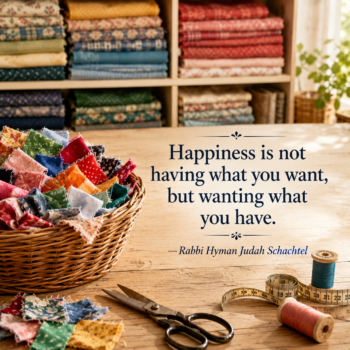
It started with a $10 bookcase. I spotted it on Facebook Marketplace last week and saw its possibilities. My little sewing room was bulging at the seams, and I had just finished making a beautiful tote bag for my granddaughter’s birthday. I thought a bookcase might give me more room to organize the chaos. It was only $10—a bargain—and it really was quite nice. I managed to get it into the back of my Subaru Outback and drive it home, where my friend, who rents the space I built for my mom, helped me unload it.
There was just one problem. The wall space where I intended to put it had a light switch. If I put the bookcase where I had planned, I would no longer be able to turn on the lights. Clearly, my $10 solution was going to require a little more thought.
Out came my blue-lined graph paper. I measured the room and drew in the dimensions, the windows and doors, the limitations and the immovables. Then I started looking at what I already had and what might be moved around. What if the sewing table went in front of the windows? What if the desk went somewhere else? After drawing it out, I started emptying the room except for the table, desk and file cabinet.
Of course, everything I removed had to go somewhere. I set up another table to handle some of it, but before long the contents of my sewing room had spilled into my bedroom, family room and back laundry room. What had begun as finding a home for one inexpensive bookcase had turned into the complete deconstruction of my sewing room.
Once the room was nearly empty, I began seeing possibilities I hadn’t seen before. The five-foot desk I already owned could be raised six inches and turned into a wonderful cutting table on wheels. My six-foot sewing table could be moved in front of the windows and given a new eight-foot top. I also envisioned a shelf along the back because I knew myself well enough to predict that without some kind of backstop, I would routinely push things right over the edge.
Fortunately, I had help. My friend has more construction knowledge and skill than I do, and after several trips together to Home Depot, we had a plan and the materials to make my drawings work. He spent two very hot days in the garage measuring, cutting, drilling and building while I worked inside sorting and folding. By then, my $10 Facebook Marketplace bargain had inspired about $250 worth of materials. The irony is that the bookcase that started the whole marathon isn’t even in the sewing room. It found a perfectly good home in my doll room where I store yarn, dolls, stuffies and finished crochet projects. (I know, enough already.)
As I began moving items back, I used the 80/20 rule as a guide. The tools and supplies I use most deserved the easiest-to-reach spaces. Fabric is the raw material I create with, so I wanted it where I could see and reach it, but it didn’t need to occupy the prime real estate reserved for the things I reach for constantly. That simple guideline made dozens of little decisions much easier.
Then Sunday morning, with my sewing room still not completely put back together, I opened an article in The Atlantic by Arthur C. Brooks called “How to Want Less”. The timing made me smile. After spending several days surrounded by my sewing and crocheting supplies, I was apparently ready for an article about “enough”—about why we humans chase satisfaction but can’t seem to hold onto it.
Brooks writes about the “hedonic treadmill”—our tendency shortly after fulfilling one desire to begin wanting the next thing. We tend to believe satisfaction will come from having more—more money, more accomplishments, more experiences, more possessions. Maybe even more fabric. Or perhaps another bookcase to hold it. His article asks what might happen if, instead of continually chasing more, we learned to recognize when we already have enough.
That question landed differently after the week I’d just spent. Emptying the sewing room forced me to look at every piece of fabric, every tool and every bin. Putting it back required me to decide what I really needed in the space. I stopped seeing my overflowing sewing room as evidence that I needed more space and began seeing how much I already had.
Meanwhile, I discovered that sorting and folding fabric takes time, particularly when you have enough of it to open your own fabric store. I found fabric I had forgotten I owned and bins of fabric that had been gifted to me—probably by someone clearing out their own sewing room! Some pieces brought back memories of things I’d made. Others reminded me of projects I once intended to make and never did.
Seeing all of my fabric folded and organized made my abundance visible. There are tote bags on those shelves that I haven’t imagined yet, dolls that haven’t been created and dressed, appliqués that haven’t been designed, and gifts that haven’t been given. I don’t need more possibilities. I already have more possibilities than I will ever have time to explore.
The volume of scraps in bins surprised me. Anyone who sews knows how useful a small piece of fabric can be. A scrap too small for one project may be exactly what I need someday for a flower, a leaf, a pocket or an appliqué. Throwing away something perfectly usable feels wasteful, yet keeping everything has a cost too. Those scraps occupy valuable space, and I have certainly learned through this experience that when too many things crowd a room, it becomes harder to see and appreciate what is there. I need to start scrapping some of my scraps and giving away fabric I know I’ll never use.
I don’t think the lesson from my week is that less is always better. That would be a little difficult to claim after spending $250 making two pieces of furniture bigger and more useful. I love fabric and yarn. I love making dolls and tote bags and discovering what I can create with my hands. I have no desire to strip my sewing room down to one pair of scissors and three neatly folded pieces of fabric in coordinating shades of beige. Creating brings me joy, and the materials and tools that make creating possible deserve a place in my life.
There is another kind of abundance I can see in that room now, although it isn’t stored on any of the shelves. I could have filled pages of blue-lined graph paper with wonderful ideas, but I couldn’t have built what I designed without my friend’s help. While I was folding fabric in the air-conditioned house, he spent two sweaty days in the garage turning my sketches into something real. Every time I roll that cutting table across the room or sit down at my new sewing table, I will be reminded of his generosity. That may have more to do with satisfaction and happiness than anything I can put on a shelf.
Now that my sewing room is completely back together, I have more workspace than I had before, but I also have something else—a greater appreciation for what was already there. I can see my fabric now. My tools are easy to reach. The room is designed around the way I actually use it, rather than around how much I can manage to squeeze into it.
The funny thing is that this whole adventure began because I thought I needed something more. I bought a $10 bookcase to solve a problem, and instead it caused me to take an entire room apart.
Perhaps enough isn’t a number on a bank statement or another rung on the ladder of success. Maybe enough is the moment when we stop looking at what is missing long enough to notice what is already here. Sometimes we may need to empty a room before we can see it.