Prefer to listen? Click here.
Make the Chili
I love fall weather. I keep my windows open day and night, and for a few glorious weeks, neither the air conditioner nor the heater is needed. Going to bed means pulling up the comforter and slipping on my crocheted slipper socks to keep my feet warm. By morning, I’m awake before the sun.
I sometimes wonder if being born on November 3 has something to do with my love of fall. Maybe the season became linked early with anticipation and celebration—Halloween barely over, my birthday arriving, and Christmas not so far away. Year after year, fall brought tumbling leaves, changing colors, and the promise of cooler days as summer released its hold. I suspect those early associations have stayed with me.
Fall in Sacramento does not always make a grand entrance dressed in brilliant red and gold. Sometimes it simply slips through an open window during the night. But it’s here. Other familiar signs are appearing. School is fully underway, and I know it’s football season. I spent many years hearing games in the background while the boys and their dad seemed to run every play from our living room—cheering and groaning with each pass, tackle, and touchdown. It was background noise then. Now I kind of miss that familiar soundtrack of fall.
Today marks the autumnal equinox—the official beginning of fall and a symbolic point of balance between light and darkness. The days will continue to shorten as we move toward winter, but today offers a pause—a moment between one season and the next.
We gather things in the fall. Like the squirrels, we prepare for winter. Crisp apples are picked, baked into pies, pressed into cider, or made into applesauce. Pumpkins ripen on their vines, ready for little ones to choose their favorites for carving. And pumpkin pie—yummy in my tummy—has its moment too. Root vegetables find their way into roasting pans and soup pots. What has grown during the light and warmth of summer is harvested and preserved for the colder months ahead.
My thoughts also begin turning toward Christmas and what I might make for neighbors and friends. September creates the lovely illusion that I have all the time in the world. If I start now, I tell myself, I won’t be rushing in December. Fabric, old jeans, bandannas, yarn, and even the gallon wine jugs stored in my garage set my creative spirit humming with possibilities.
I may not spend fall canning tomatoes or putting up jars of fruit, but I begin storing something else for the months ahead. A few stitches here, an idea sketched there, and love begins accumulating in the form of things made by hand. But not everything worth gathering can be canned, sewn, or wrapped. Some things must be gathered before it is too late.
Before Mom came to live with me, I began creating a digital archive by scanning photographs from her childhood and from her mother’s albums—precious images, some nearly 100 years old. I had completed 135 of them when, at a family reunion one year after Michael died, I pulled them up on my laptop to surprise her.
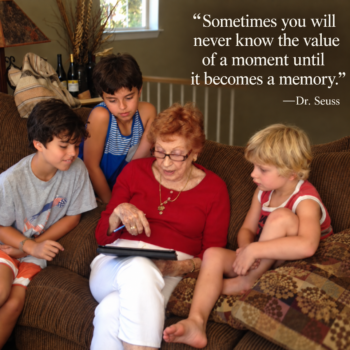
When Mom saw the photographs, her eyes filled with tears, and she clapped her hands in delight. Her great-grandchildren, grandchildren, and nephews gathered around as she clicked through the pictures, naming the people, describing the occasions, and sharing detailed stories about the family members who had come before us. Photographs that might have meant little to the younger ones came alive through her memories.
At 89, Mom was still living fully on her own. That afternoon, she became the center of the gathering—the Queen Bee, a role she loved. She was our family historian, the only person left who carried many of those names, relationships, and memories. For a little while, the people in those old photographs lived again.
At the time, I thought the photographs were the treasures. I didn’t fully understand that Mom’s stories were equally precious—and far more fragile. My sister and I encouraged her to write down parts of her life, and we made some recordings over the years. We tried. Still, many of the stories only she could tell were lost when she died.
After her death, I scanned the remaining photographs while preparing for her memorial. I know she would have loved seeing all of them preserved in digital form. The photographs survived, some for nearly 100 years. Not all the stories did.
No one can preserve an entire life. What we can do is recognize more of the opportunities we are given to ask, listen, and be present. That brings me to a very short story I saved called “Make the Chili.”
A man who had recently and unexpectedly lost his wife was playing golf with a friend. During their conversation, the friend mentioned that his wife wanted his homemade chili and cornbread for dinner, but he didn’t feel like stopping at the store for the ingredients.
The widower quietly told him, “Make the chili.” It took the friend a moment to understand that they were no longer talking only about dinner.
His friend was telling him to go to the store, make the meal his wife loved, and appreciate the ordinary opportunity before him. There might not always be another evening, another dinner, or another chance to respond to a small request from someone he loved.
“Make the chili” has become shorthand for all those moments when love asks a little something of us. Go for the walk. Attend the performance. Put down the phone. Play the board game. Pull up a chair. Listen to the story you may have heard many times before.
Sometimes it may mean opening an old photograph album and asking, “Who is this? What do you remember?”
We seldom recognize such moments as important while we are living them. They don’t arrive with announcements telling us that this conversation should be recorded, this story should be written down, or this ordinary evening will someday be deeply missed. They look like interruptions, errands, repeated stories, or things we can easily do another day.
I don’t believe the lesson is that we must say yes to every request or capture every memory. We couldn’t possibly do that. Nor do I want to examine my past in search of all the things I might have done differently. I loved my mother, although I could have been more patient at times. I was Michael’s greatest fan, even if hindsight sometimes shows me other ways I might have supported him. I know I did the best I knew to do at the time.
My life today is relaxed and largely unencumbered. I seldom feel too rushed to make the chili. My challenge may be simpler—to recognize the invitation when it appears. An ordinary conversation, a question about the past, or a request to spend time together may be offering more than I realize.
Hindsight reveals how easily we assume that another opportunity will come. We believe there will be another afternoon for asking questions, another performance to attend, another recipe to make, or another call to connect and just say hi. Usually, there is—until there isn’t.
Make the chili.
If this Cuppa Joy stirred something in you—a memory, a smile—I’d love to hear your thoughts in the comments below.