Prefer to listen? Click here.
Old Enough to Know Better
Age—it seems to be a popular subject these days. Boomer celebrities and influencers are celebrating turning 70 and announcing that life doesn’t end there. I find myself smiling and thinking, “You’re right. Welcome to the club.” Born in November 1945, I missed being an official baby boomer by less than two months, giving me a sneak preview of each new stage before the crowd arrives.
Of course, I owe an apology to any readers in their late eighties or nineties who are smiling at my observations. I can almost hear them saying, “Been there, done that. Just wait.” Apparently, we’re all getting sneak previews from someone while offering them to someone else. And none of us really knows what’s coming until we arrive.
I used to think people in their eighties were really old. Then I arrived and began wondering what else I’ve been wrong about. Of course, there are changes. I move a little more slowly, and I’m definitely not climbing onto a bicycle and riding 500 miles along the coast as I did 22 years ago. But when I see people in their eighties portrayed in movies or books, I often have trouble recognizing myself in those feeble characters.
Since this week’s Cuppa arrives on my 81st birthday, I thought I’d indulge in a little reflection on aging, the numbers we attach to it, and the curious ways we see ourselves as the years accumulate.
In my thirties, I read Gail Sheehy’s bestselling book Passages, published in 1976 when she was just 39. She explored the stages of adult life, from the trying twenties through the thirties, forties, and into the fifties. And then her map essentially ended as if there wasn’t much territory left to explore. At age 57, she published New Passages, extending her exploration into the later decades, including what she called the “Uninhibited Eighties.” Yet she hadn’t even reached 60 herself. I find that fascinating. We can observe our parents and grandparents, read books about aging, and listen to people who’ve traveled ahead of us. But how can we really know what an age will feel like, much less write about it, until we get there? Even then, we only know our own experience.
When we’re children, we can’t wait to grow older. My son John, three and a half years younger than his brother Troy, was always eager to catch up. When Troy started kindergarten, John wanted to go, too. When Troy joined the swim team, John wanted to join him. On John’s fourth birthday, he blew out the candles on his cake, turned to me, and asked, “And when will I be five?” Apparently, four was already old news. He had a big brother to catch up with, although he hadn’t yet figured out that Troy would always be three and a half years ahead.
Somewhere along the way, our enthusiasm for adding years begins to change. Those birthdays ending in zero take on a significance they didn’t have when we were young. Forty can make us wonder whether we’re still young, fifty marks half a century, and sixty brings retirement into view. But what about seventy or eighty? What exactly are we celebrating? And when did we decide it was impolite to ask a woman her age? Somewhere in those middle years, we seem to go from eagerly adding years to quietly subtracting them.
I confess I did a little subtracting myself. When I was in my late fifties and exploring online dating, I noticed that men my age often seemed interested in younger women. So I sometimes shaved five years off my age, hoping not to be eliminated before anyone had a chance to know me. Then I’d feel guilty about it. Apparently, I was willing to fib about my age but wasn’t particularly comfortable being a fibber. Maybe that’s why the online dating scene didn’t work for me.
These days, I’m happy to announce my age. I was genuinely excited about turning 80 last year, not just because of the number but because of the journey that brought me there. Growing old is a privilege not everyone receives, and I’ve lived long enough to appreciate that.
My mother was twenty years older than I am, so I’ve often used her as a reference point for what lies ahead. She lived to almost 96, and although her physical health declined during her final year, she remained interested in the world around her. She worked thousand-piece jigsaw puzzles until the last few months, when we switched to 300 pieces. She read, watched CNN, followed politics, and played Scrabble on her phone. Her memory wasn’t quite as sharp toward the end, but she never experienced the devastating cognitive decline that my grandmother had with Alzheimer’s.
My father worked into his eighties, designing engineering solutions for a company that manufactured enormous commercial insulation blankets. Parkinson’s eventually affected his health, but he continued using his problem-solving abilities for many years. I’ve had different examples of what aging can look like, and I know how fortunate I am to have reached 81 with my health, curiosity, and independence reasonably intact.
But aging isn’t a competition. None of us gets to choose all the physical or mental challenges that may come our way. We can take care of ourselves, but there are no guarantees. And I don’t want to turn growing older into another performance contest.
I spent 25 years in real estate, often comparing my sales with those of other agents. Most of that pressure came from me, and one of retirement’s unexpected pleasures has been the relief of no longer having to measure my performance against someone else’s. It would be rather foolish to trade that scoreboard for another one based on who looks younger, walks faster, remembers more, or has fewer wrinkles.
Speaking of looking younger, I’ve noticed friends posting AI-generated photographs on Facebook that place them in glamorous settings while removing years from their faces and pounds from their bodies. I understand the appeal, but I’ve been thinking it might be more entertaining to take a photograph of myself and age it another twenty years. Imagine how much better I might feel about the face I have today. After all, when I look at photographs from twenty years ago, I wonder why I was so critical. Apparently, we’re always comparing ourselves with a younger version, without realizing that today’s version is the one we’ll someday wish we still had.
I once read a piece comparing life to a box of chocolates. When the box is full, we eat without paying much attention to how many remain. As the supply dwindles, we begin savoring each one a little more. I like that image, although I don’t feel any particular urgency to hurry through the chocolates I have left. I’m quite content to enjoy whichever one I happen to be eating.
Maybe that’s what turning 81 means to me. I’m not trying to be younger, and I’m not in a hurry to be older. I appreciate the years I’ve been given, including the ones that brought challenges I wouldn’t care to repeat. I know there may be difficulties ahead, but I’m not inclined to borrow trouble from a future that hasn’t arrived. I’ll continue writing my Cuppa Joy as long as I feel it has value, and I’ll keep playing with fabric and yarn, creating bags, dolls, stuffies, and crocheted gifts as long as I’m having fun.
Perhaps being old enough to know better means finally understanding that there’s no need to compete with yesterday’s version of ourselves—or with anyone else. We can simply enjoy being who we are, at whatever age we happen to be.
For now, I’m here. I’m curious. I’m enjoying myself. And I’m grateful to have another birthday to celebrate. And if I make it to 101, I hope someone takes my picture. I may finally appreciate how young I looked at 81.
If this Cuppa Joy stirred something in you—a memory, a smile—I’d love to hear your thoughts in the comments below.
1 Comment. Leave new
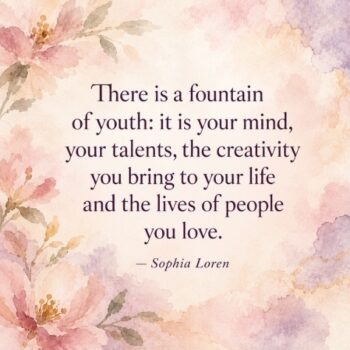
Hello All, Robyn’s my sister, 3 years older than me, and I am writing to salute her for the wonderful model of aging she’s being and all she’s been doing these past several years. What a huge fountain of creativity has erupted from her: The dolls she’s made, the stuffed animals, the crocheted washcloths, now the one-of-a kind bags, and all these years of Cup A Joy messages. It wasn’t always easy being my big sister, I had a knack for claiming the lime-light more than my share of the time, but today I am shining that lime-light on her. What a wonderful mother, sister, friend and woman you are! Love, ALORAH