Prefer to listen? Click here.
Does it Matter that We Matter?
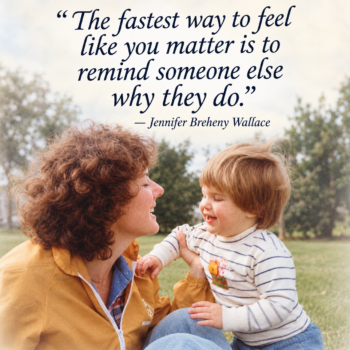
I’m listening to a book called Mattering by Jennifer Wallace. I’m not even sure how it landed in my world, but I’m struck by how well she articulates something I’m sure we can all relate to. How do we know if we matter? And how does feeling like we do—or don’t—matter, matter? Yes, I deliberately used that word twice.
Jennifer describes mattering as a meta-need, something that encompasses belonging, connection, recognition, and purpose. She explains that beyond our basic survival needs, such as food and shelter, the desire to matter is a powerful motivation in human behavior.
And belonging isn’t necessarily the same as mattering. A person can belong to a family, be invited to every gathering, and still feel that nobody particularly notices whether they’re there. Someone can work for an organization for thirty years, retire, and wonder whether anything they contributed is remembered.
A parent can spend decades being needed every day, and then the children grow up and build lives of their own. Parenting is complete. Job well done. Now what? I believe one of the gifts we can give our grown children is recognizing when our parenting role has ended and allowing our relationship to become one of adult companionship. I experienced that transition with my mother, and I’ve found it equally meaningful with my sons. But even a happy transition can leave us wondering where our importance went when we’re no longer needed in quite the same way.
As we age, other roles that once gave our lives purpose may also disappear. We may no longer be the person earning a paycheck, making decisions, or being called upon for advice. How do we keep feeling like we matter?
Recently, I read a Facebook story about Paul Newman bringing food to a homeless shelter on Christmas Eve in 1983 and helping cook and serve it. One man supposedly told him, “He made me feel like I still mattered.” I thought it would be a wonderful story for Cuppa Joy. After all, food addresses a physical need, while taking time to listen to someone addresses another— the need to be seen and treated with dignity.
But when I looked into the story, I couldn’t find reliable documentation that it happened. No contemporary reporting, identifiable shelter, or independently verified eyewitness account. Perhaps something like it happened— I don’t know. But I can’t present it as fact.
I always feel disappointed when this happens. There is so much genuine goodness in the world. Why invent stories and say they’re true? I love stories of kindness, but I want to know what’s real. And Paul Newman’s charitable legacy needs no embellishment.
In 1982, Newman and his friend A. E. Hotchner started Newman’s Own, initially selling salad dressing, and decided to donate its profits to charity. According to the Newman’s Own Foundation, the company has since contributed more than $600 million to charitable causes. Newman also founded the Hole in the Wall Gang Camp, which opened in 1988 to give children with serious illnesses a chance to enjoy the fun and friendships of childhood. I buy Newman’s Own products because they’re good and because I like knowing my purchase helps someone else.
I’m not opposed to fiction. I just want to know up front. One of my favorite fictional stories, almost as old as I am, is the 1946 classic It’s a Wonderful Life, starring Jimmy Stewart. For eighty years, George Bailey has shown us something about the value of an ordinary life.
George didn’t know how much he mattered. He was so caught up in disappointments, unfulfilled dreams, and missed opportunities that he couldn’t recognize the difference he’d made. He needed Clarence to show him a world in which he’d never existed and how the ripples of his life reached far beyond what he could see.
Unlike George Bailey, we don’t have a Clarence to show us what the world would look like without us. That’s why I believe it’s so important that we become the earth angels who remind one another that we matter.
My sons do a wonderful job of this. They make time for me and handle some of the honey-dos that I no longer can, or perhaps never could, take care of. They listen, call, remember my birthday and Mother’s Day, and tell me how much they love and appreciate me. I know I scored big in the son department. They let me know they want me in their lives and that their world is better because I’m in it. What a gift.
I’m also blessed by those who tell me how much they look forward to Cuppa Joy. I sit down each week and share my observations, not knowing who will listen or read or what they’ll take away. But often enough someone reaches back across that invisible distance to tell me something I’ve written touched them. And I experience mattering. That’s my little glimpse into the world George Bailey was shown— something I did made a difference.
Not everyone has children who express their affection so openly, and not everyone hears encouragement for the things they do. Some people have loving families and friends who simply aren’t very good at putting their appreciation into words. Does that mean they matter less? Of course not. Our worth doesn’t depend on someone recognizing it, but if we don’t see our value reflected back to us, it can be terribly hard to see it for ourselves. We are mirrors for one another.
Think about a child growing up. How does that little person begin to understand who they are? So much comes from the faces, words, and responses of the people around them— a parent’s delight, a teacher’s encouragement, a grandparent who listens as though every word is important. Those reflections help a child see themselves as worthy of love and respect.
But what happens when the mirrors reflect criticism, indifference, or rejection? A child may grow into adulthood carrying a distorted picture of their own worth, with a great deal of repair work to do. I suspect many of us carry a few cracks from those early mirrors. Even those surrounded by love can have their sense of mattering shaken by loss, retirement, illness, or other changes. We need positive reflections throughout life, not because our worth disappears when nobody notices it, but because we sometimes need help remembering what is true.
What a wonderful world it would be if we could reflect the beauty in one another more often. Not with empty compliments, but by noticing someone’s kindness, courage, humor, or persistence and telling them what we’ve seen. Sometimes a few sincere words can help someone recognize a part of themselves they’ve overlooked.
We may never know how much we’ve mattered to someone else. A teacher may never hear from the student whose life she changed. A neighbor may never know that a friendly greeting was the brightest moment of someone’s day. The ripples keep moving long after we’ve forgotten what started them.
And I wonder about those who feel invisible, including people experiencing homelessness or struggling with addiction. How much of their pain might include the belief that they don’t matter? I don’t pretend those struggles have a single cause or a simple solution. A kind word cannot replace housing, treatment, or recovery support, but it can say, I see you. You’re a person, not a problem. Your story matters.
I keep coming back to George Bailey. How many people are living with their own version of his despair, without a Clarence to show them otherwise? We can’t offer a magical glimpse of the world without them, but we can tell people about the difference they’ve made in ours. We can thank an old friend for a kindness they may have forgotten, tell someone we’ve missed them, or simply listen.
I wonder what might change if we remembered to be more generous in reflecting the goodness we see in others and acknowledging it in ourselves. We can sprinkle our self-talk with “atta-boy” or “atta-girl” and “good job.” Most of us won’t meet a Clarence, but we can become a little bit of Clarence for one another. And wouldn’t that make it a wonderful life?
If this Cuppa Joy stirred something in you—a memory, a smile—I’d love to hear your thoughts in the comments below.