Prefer to listen? Click here.
Beyond the Labels
Hard to believe she’s gone. Dolly Parton—truly a legend. Social media immediately erupted with clips from interviews. “9 to 5” played on repeat. I rode the wave of sorrow and joy—laughing and choking up as I listened and watched. Dolly consistently showed us her humor, her tender heart, and her wisdom, often with a wink and a laugh. I loved it when a teenage boy asked her for a piece of advice. She paused, gave it a moment, and said, “I would say, act like it’s raining every day and wear your rubbers.”
Then she immediately realized the double meaning, blushed, and said, “I’m sorry, but even my face is red. I don’t believe I said that!” The audience erupted. It’s wonderfully Dolly—quite possibly sensible advice hidden inside a naughty joke, followed by that delighted, mock-innocent embarrassment—definitely a Dolly trademark.
The tributes have celebrated her remarkable accomplishments as a singer, songwriter, actress, businesswoman, and philanthropist. She certainly earned every one of those accolades. What inspires me even more is her authenticity, her willingness to be completely herself, and the affection she expressed for people. She had a way of seeing beyond appearances and circumstances to the possibility within.
When Dolly was still an impressionable little girl, she saw a woman she would later describe as “the most beautiful woman I had ever seen.” The woman’s peroxide-blond hair was piled high, and she wore bright red lipstick, long fingernails, high heels, and tight skirts. The adults called her the town tramp. That didn’t discourage Dolly. If that was what trash looked like, then trash was what she wanted to be when she grew up.
Years later, people in the music industry advised Dolly to tone down her appearance if she wanted to be taken seriously. She ignored them. She said the way she looked needed to match the outgoing person she was inside. Her appearance may have been constructed with wigs, makeup, acrylic nails, rhinestones, and carefully fitted clothes, but the woman wearing them was remarkably genuine. Dolly knew exactly what she was doing, and she did it on purpose.
What touches me most about that childhood story is not simply that Dolly developed her signature look from someone others dismissed. She saw beauty where the adults around her had placed shame. She didn’t yet know what the label “tramp” meant. She only knew that the woman was colorful, flamboyant, and beautiful. Before Dolly became someone who encouraged millions of people to believe in themselves, she was a little girl who refused to let other people tell her what beauty should look like.
She had the same ability to see beyond a label when she spoke about her father. Robert Lee Parton never had the opportunity to learn to read and write, but Dolly wanted people to understand that he was far from unintelligent. She described him as one of the smartest people she had ever known. He was a hardworking farmer and a good businessman, but his inability to read limited the opportunities available to him.
Dolly could not go back and give her father the education he had missed, but she could help other children receive an earlier chance. In 1995, she created the Imagination Library in her home county in Tennessee. The program began mailing one free book each month to children from birth until they entered kindergarten. It eventually expanded far beyond Tennessee and distributed more than 300 million books in several countries.
What began with Dolly’s love for her father became an opportunity for millions of children. She did not confuse his lack of education with a lack of ability, nor did she assume that children born into homes without many books lacked imagination. They simply needed someone to place a book in their hands and give them a chance to shine.
Although she lived much of her life in public, Dolly kept important parts of herself away from view. Her marriage was private, as was much of her writing life. She described songwriting as both private and spiritual, a time when she could be alone with God and remain open to whatever wanted to come through her. Dolly knew she possessed both talent and discipline, but she also regarded her gift as something she had received. She called God her co-writer. Her responsibility was to remain receptive, capture the words and melodies when they came, and then offer them to the world.
Sometimes she deliberately retreated to the Smoky Mountains to write. She might drive until she found a quiet place beside a creek or river and sit with her guitar and the fragments of songs she had collected. At other times, inspiration found her in the middle of a busy day.
While filming the movie 9 to 5, Dolly noticed the rhythm of the people and activity around her. During the waiting time between scenes, she clicked her long acrylic fingernails together and realized they sounded like a typewriter. That small sound became the distinctive beat of “9 to 5.” In the middle of a crowded movie set, some part of her was still listening.
Dolly kept recordings of her song ideas in chronological order on cassette tapes. Years later, she found “Jolene” and “I Will Always Love You” recorded close together on the same cassette. She couldn’t say with certainty that they were written on the same night, but she knew they had come within a short span of time. She laughed about what a good writing session that must have been.
A song could remain unmistakably hers and still take on a new life in someone else’s voice. Dolly told the story of driving when she unexpectedly heard Whitney Houston singing “I Will Always Love You” on the radio. At first, she didn’t recognize the unaccompanied opening. Then Whitney reached the familiar words, and Dolly realized she was hearing her own song. Overwhelmed, she had to pull off the road to listen. She marveled at how Whitney had made the song greater than Dolly had ever imagined it could be.
I recognize something of that mystery. Sometimes I reread something I wrote years ago and wonder where the words came from. Once we bring our creations into the world, we cannot know w hom they will reach or what they may become in someone else’s hands. Something I write alone at my keyboard may speak to someone in a way I never imagined. A song written years earlier can one day stop its writer beside the road when another woman gives it a new voice.
Dolly Parton had the courage to be fully herself, the stillness to listen for what wanted to come through her, and the generosity to rejoice when what she created shone through others. She saw beauty in the woman others called trash. She saw intelligence in a father who could not read. She saw possibility in children who needed books. She heard music in the clicking of her fingernails and welcomed the new life another singer gave her song.
Again and again, Dolly looked beyond the labels and limitations that might have caused someone to be overlooked. She used her music, money, humor, influence, and love to give people a chance to shine.
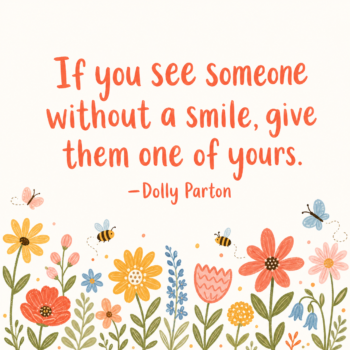
Dolly reminds us to look with fresh eyes at the people around us. Who have we limited with a label? We may not be able to give millions of books or write a song the whole world will sing, but we can choose to look beyond the labels and see possibility. We can give a smile to someone who needs one.