
(Prefer to listen? Tap here)
Finding Joy in the Midst of Sadness
How do we respond when someone we love is experiencing deep sadness? Drawing from friendship, grief, and recent research on happiness, I explore why joy isn’t one-size-fits-all — and how quiet companionship may be the greatest kindness we can offer one another.
I’ve been thinking about this lately—how do we respond to another’s sadness? I know what to do when a friend has taken a spill and can’t get up. I have literally called 911 twice because I needed the help of emergency services after trying to help them up by myself.
But when someone falls deeply into sadness, what’s the 911 call?
I have a dear friend, one of my favorites. I love spending time with her. We can talk about anything. She is a joyful person by nature. She loves decorating for every season, opening her home for neighborhood gatherings, surrounding herself with family and friends. The long isolation of COVID was especially hard on her extroverted spirit. She says it’s because she comes from a big Italian family—gatherings are part of their culture.
Maybe. I’ve known her long enough to see how tender-hearted she is. She is deeply affected by world events, feels the pain others are going through, and has lost many loved ones herself. Sadness is no stranger to her.
She asked me recently, “You always seem able to find something positive. How do you do it?” I felt the tenderness inside her question. Part curiosity, part longing. I wanted to hand her a simple answer—a small formula she could tuck into her pocket and use when the days feel heavy. But I had no honest one-size-fits-all formula to offer.
We have both buried adult sons—sons who brought us enormous joy. Sons who didn’t always fit easily into this world. Sons whose absence altered the landscape of our lives in ways no one truly understands unless they’ve walked this road themselves. It’s a club no one wants to join.
We miss our sons. We share stories about who they were. We wonder what life might look like if they were still here. We still feel the echo of their laughter and the ache of unfinished conversations. We’ve both had to learn how to live with grief—how to make space for it, how to sit with it when it bubbles up.
I’m also a joyful person, but I’m nourished by quieter rhythms. I love my solitary mornings with writing and journaling. I’ve learned to notice beauty where it still insists on showing up—in the squeals of my neighbors’ children, the fun of movie night with a friend, a walk in the neighborhood with Moxie, a pop-in visit from my local son, a weekly check-in call from my eldest in Idaho—all the ordinary bits of being alive that keep love circulating.
Her comment lingered with me long after our conversation ended. Not because I felt misunderstood—but because I could feel the quiet question underneath it. Why does joy seem more accessible to you? Why does my sadness feel heavier by comparison? What am I missing? I don’t believe she was asking for a formula. She was naming a mystery.
Here we are—two mothers missing our sons. I can see how differently our grief lives in our bodies. Neither of us is wrong. We are simply wired differently. Two nervous systems learning how to carry love, sadness, and loss.
She got me thinking about happiness and joy—how we create it, whether it’s mostly an inside job or something determined by our circumstances. I’ve lived inside both possibilities at different times of my life. In my younger years, I believed changing the outer landscape was the only way to find more happiness. Over time, I learned that, for me, satisfaction and joy are very much an inside job—shaped by my perceptions and choices.
I came across a research study out of UC Davis that felt like it illuminated that mystery rather than trying to solve it. Psychologist Emorie Beck and her colleagues analyzed decades of data from tens of thousands of people around the world, studying how changes in life circumstances and changes in mindset affected people’s long-term wellbeing. What they discovered quietly dismantled the idea that there is a universal path to happiness.
Some people genuinely experience greater wellbeing primarily through what researchers call a “top-down” pathway—shifting perspective, meaning-making, gratitude, reframing how they interpret their lives. Others experience wellbeing primarily through a “bottom-up” pathway—changing the conditions of their lives: safety, relationships, work environments, financial stability, daily rhythms. Some people benefit from both.
The wellness world has spent decades selling us the idea that joy can be engineered with the right morning routine, mindset practice, affirmations, supplements, breathwork, and gratitude journals. When those things don’t work for someone, the quiet shame creeps in—something must be wrong with me. I must not be doing it right. I must not be disciplined enough, spiritual enough, positive enough.
The research says otherwise. Our nervous systems are not interchangeable. Our histories shape how safety, meaning, and hope re-enter the body. What opens one heart may barely move another. In other words, there is no single recipe for how human beings find their way back into aliveness.
Knowing this allows me to tell my story without carrying the feeling that I have the answer or must offer advice. My capacity to notice beauty alongside grief is not a moral achievement or a spiritual badge. It is simply the way my nervous system learned how to survive love and loss. Joy is not transferable like a recipe card. What helped me cannot automatically help others.
This research honors the sacred individuality of how each of us responds to pain and joy. It gives permission for curiosity rather than comparison. It leads us to ask ourselves, “When do I feel joyful? What, if anything, do I need to change?”
In a way, it reminds me of the quiet wisdom of the Serenity Prayer—learning to accept what cannot be changed, finding the courage to change what can, and cultivating the discernment to know the difference.
For some, joy may show up with a shift in perspective—noticing what is still here, cultivating gratitude, choosing where attention rests. For others, joy may emerge through changes in the outer world—different rhythms, deeper connection, new forms of purpose, more support, fewer chronic stressors. For many, it will be some tender weaving of both.
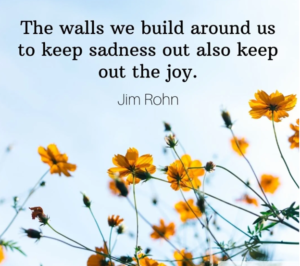
What I know to be true is that joy does not cancel sorrow. It does not betray love. It does not erase memory. It stands next to sadness, inviting us to feel both at once. They live side by side. If we try to close our hearts against pain, we are also blocking joy.
When I’m with my friend and she’s vulnerable enough to share that she’s feeling sad, my work is to stay present and listen—to share what helps me, but not as a formula. Her sadness is a measure of her love. It deserves reverence, not correction. She deserves tenderness and moments of light in the midst of her sadness.
Perhaps the deeper invitation for all of us is to begin discovering our own joy maps—listening more closely to our lived experience. What brings a quiet smile? What opens our heart? What feels nourishing to our soul?
Our joy is something we gently discover, again and again, in honest conversation with our own nervous system and our own story. Sometimes it may be an inside job. Other days it may mean making a change in our circumstances.
And maybe that is the truest kindness we can offer one another—not a recipe for happiness, no 911 calls needed, but quiet companionship while each heart learns, in its own time and language, how to notice the joy that never left, patiently waiting to be noticed.