
Prefer to listen? Click here.
Giving the Gift of Being Seen
Morning Cuppa Joy is just over six years old. It has become my weekly practice of noticing the beauty that surrounds us and reflecting on what it means to be human—through love, creativity, inspiration, and healing. Much of my joy comes not only from writing each week, but from the positive comments I receive.
I hope I can convey to each of you how much your kind and thoughtful words mean to me. I often find myself with “happy tears” running down my cheeks. Last week was one of those times when one comment in particular really helped me with my internal critic.
It has to do with my voice, so I need to give you some background. While I’ve written over 330 issues of Cuppa Joy, I only started recording them in late December last year. When I finished recording the first one, I almost gave up. My voice did not sound like me. I even called my son Troy and had him listen to what I had recorded. He reassured me that it was the voice he loved—the voice of his mom.
So I persisted. Each week I now record Cuppa Joy, and those recordings make their way onto YouTube, podcast platforms, emails, and my website. Along the way, I’ve stretched my technology skills and probably created a few new brain cells—a good thing at my age.
Last week, I received a notice that I had “fan mail.” I’m used to emails and texts, but this was new and exciting. I opened it to find a lovely message from a Texan. My friend and I had met him and his wife over breakfast on our recent Alaskan cruise. He began listening to my Cuppa Joy and was enjoying it.
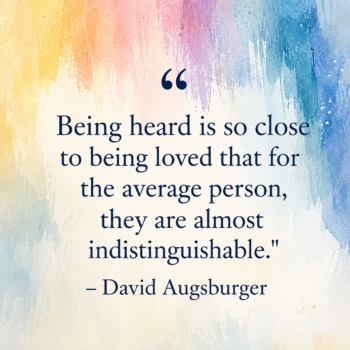
His message made me smile. But my lumpy throat wasn’t just because he had complimented my podcast. It was his comments about my voice. He said my voice made him want to listen rather than read the transcript, which he usually prefers. He told me my voice was helping him. He described my words as kind and my message as clear. It made my day. He confirmed for me that the voice I had been so unsure of was, in fact, carrying the love I hoped people would hear. I felt seen.
What a difference it makes when someone truly sees us—when they notice something in us that we’ve overlooked or struggled to see in ourselves, especially something we’ve been critical of. This experience reminded me of a couple of stories—one that is quite old, and another that is very fresh.
The first is an old tale whose origins are uncertain, but the lessons are timeless. Here’s my summary of The Rabbi’s Gift.
A once-thriving monastery had fallen into decline. Only a handful of aging monks remained. Discouraged and resentful, they had lost the joyful spirit that once drew people to their community.
Hoping for guidance, the abbot sought out an old rabbi who lived nearby. After listening and exchanging tea and news, the rabbi offered only one piece of advice. “The Messiah is among you,” he said.
Puzzled, the abbot returned and repeated the rabbi’s words to the other monks. One of us? they wondered. Could it be Brother Thomas? Brother Joseph? The abbot? Could it even be me?
Since none of them knew, they gradually began treating one another with extraordinary respect, just in case. And, on the off chance that he himself might be the Messiah, each monk also began treating himself with greater dignity.
Slowly everything changed. Joy returned. Visitors sensed something different and began coming again. Word spread. Young men asked to join the order, and before long the monastery flourished once more—not because they discovered who the Messiah was, but because they began seeing one another differently.
The second story, Theo of Golden by Allen Levi, came into my life because my friend Patti recommended it after reading one of my essays. I loved it so much that I recommended it to our book club, where Patti and I are both members. That was before it became a bestseller and one of the most remarkable publishing stories in recent years. It wasn’t propelled by controversy or celebrity. It grew because readers loved it enough to tell someone else. Then those readers did the same. Like the monastery story, it spread one person at a time.
Why? What made it grow? What did Allen Levi tap into with his Theo character?
Theo is an 86-year-old gentleman from Portugal who arrives unexpectedly in the small town of Golden, Georgia. Almost everything about him is wrapped in mystery. Yet wherever he goes, something changes. Theo has a remarkable ability to relate to people who are very different from him. His genuine interest in others begins to change how the people of Golden see themselves—and one another.
Theo bestowed a gift to those he interacted with—not just a physical gift, but the gift of seeing themselves with new eyes. He helped them see that they were important, that their life stories were worth taking the time to hear. He listened. He made connections between people.
I won’t try to review the book or even summarize the plot, because it wasn’t the story that stayed with me as much as the feeling that remained long after I finished it. In fact, as I read it, I kept hoping it was a true story. It wasn’t. But it could have been.
Later I learned that Theo was inspired by Allen Levi’s younger brother, who had passed away—someone we would have all enjoyed meeting. That made perfect sense to me. Theo felt wonderfully real because he was rooted in someone who had truly lived, as were many characters in the book.
Human connection expert Riaz Meghji suggests that beneath almost every interaction, we subconsciously ask three unspoken questions: Do you care about me? Are you listening to me? Can I trust you? We rarely ask those questions aloud, but we are almost always looking for the answers. Allen Levi might add a fourth question: “Is love present?” He writes, “For anything to be good, truly good, there must be love in it.”
The rabbi invited the monks to see something sacred in one another. Theo saw something in each person that they could not yet see in themselves. Perhaps these are simply two stories in a long tradition of stories that remind us to look at one another through the eyes of love and compassion.
Most of us can remember someone who did that for us—a parent, a teacher, a coach, a friend. Someone who looked beyond our uncertainty and recognized a strength or possibility we hadn’t yet discovered or claimed for ourselves. Years later, we may not remember every word they spoke, but we remember how they made us feel.
What might happen if we treated every person we met as though there were something precious and sacred in them yet to be discovered? Some stories make me want to be and do better. Theo of Golden was one of those.
Sometimes one of the greatest gifts we can give another person is seeing something true and beautiful about them that they couldn’t quite believe on their own—then taking the time to tell them. It can be life changing.