
(Prefer to listen? Tap here)
Noticing the Beauty
I will be celebrating Earth Day this year on a cruise ship in Alaska.
It’s my second time there. I first visited Alaska in August of 2013. I was so excited when I booked the trip, and then, just days before we were to leave, my youngest son, Michael, died suddenly in an auto accident. It didn’t feel like the right time for a vacation. My grief was still so close, so present, so unpredictable.
Faced with this, I had a decision to make—stay home or go? Either way, I would still be feeling the depth of his loss. I listened to my heart and chose to go. Michael had always wanted to go on a cruise ship, so I took some of his ashes with me. Just a small container.
I scattered some into the sea, where the whales move through deep, ancient waters. Some stayed in the rainforest, among towering trees and soft, living earth. And some, very discreetly, found their way into the sawdust on the floor of the Red Dog Saloon.
I never knew when memories would flood me with tears. I took it one day at a time, one memory at a time. Grief woke me early on the morning of August 15, three weeks exactly from Michael’s death. Not wanting to disturb my roommate, I bundled myself in the guest robe and headed to the top deck. The air was misty, the deck was slippery, and I was alone with my tears.
At least I thought I was alone. As clearly as if he were standing right behind me, I heard Michael’s voice.
“Mom, pay attention to the beauty all around you. Don’t miss it being sad, wishing things were different. I’m right here.” It stopped me mid-sob.
I opened my eyes. And all around me, in every direction, the sky had come alive—purples, golds, reds—every color imaginable in the morning spectrum, stretching in a full circle around the ship. A 360-degree sunrise, more beautiful than anything I had ever seen.
I stood there, no longer crying, simply witnessing. I will always remember that morning. I knew his spirit was with me—I could feel his presence. His reminder to stop wishing things were different still guides me today.
Now, I am returning to Alaska. I anticipate changes. Glaciers that were already receding in 2013 are still melting and splitting off in huge chunks. Shorelines are shifting. Forests shrinking. Our planet is wearing the scars of how we have lived upon it.
For me, if I’m not mindful, this awareness can feel overwhelming. Too large. Too complex. Too late. And yet, I find myself returning to that morning on the deck. “Pay attention to the beauty all around you. Don’t miss it being sad, wishing things were different.”
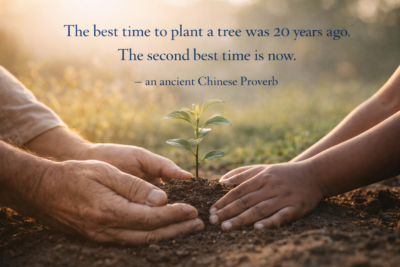
Because beauty still surrounds us. And people are responding with care. Scientists and innovators are rethinking how we use what we’ve created. Individuals are planting trees, cleaning rivers, reimagining waste as something that can be reclaimed and used again. It’s quiet, steady work—often unseen—carried out by people who refuse to give up on the possibility of healing what has been damaged. Not because it is easy. But because it matters.
Earth Day reminds us that this planet we share is not just a backdrop to our lives. It is where we place what we love. It holds our memories, our stories—even the physical remains of those we have lost. It is both fragile and resilient, changing and enduring, wounded and still capable of renewal.
One of the individuals making a difference lives in India. His name is Jadav Payeng, but he is often called the “Forest Man.” As a young boy, Jadav watched the land around him being stripped bare by erosion. Trees disappeared, wildlife vanished, and the ground hardened into something lifeless. Troubled by what he saw, he took action.
He planted a tree. And the next day, he planted another. For more than forty years, he continued—one tree at a time—until what had once been barren land became a thriving forest spanning more than a thousand acres. Today, that forest is home to elephants, rhinos, birds, and countless other forms of life.
He is still there, tending the land, continuing the work—not for recognition, but because he cares deeply for the place he calls home. His story has since inspired others, but at its heart, it remains something very simple. One person, paying attention to what was being lost, and choosing to respond with care. Learn more here.
Another individual responding with care is nurseryman David Milarch. His life took an unexpected turn after a near-death experience. It left him with a deep sense that he was meant to do something meaningful by helping preserve the world’s oldest and strongest trees.
Through the Archangel Ancient Tree Archive, he and his team focus on what are called “champion trees,” the largest and oldest of their kind—trees that have endured storms, drought, fire, and time itself. Rather than simply planting new trees, they take cuttings from these ancient giants and grow new trees from their lineage, planting them in forests, preserves, and even in cities.
One of those places is Detroit, where he partnered with Arboretum Detroit to plant a new generation of giant sequoias in the heart of the city. In a place once defined by industry and loss, these ancient champions are being given new life, their roots settling into urban soil.
These trees have endured for centuries. Milarch isn’t just planting for the future, he’s protecting and preserving them—making sure we don’t completely destroy them. Learn more here
Thankfully, the Forest Man and Milarch are not the only ones paying attention and choosing to care in whatever ways they can. Work like theirs may take years to create an impact, but these stories encourage us to turn from despair to hope. They remind us to focus on this beautiful planet we call home and on the potential for renewal.