
Prefer to listen? Click here.
Our Freedom to Choose
Today’s Cuppa Joy focuses on the layered concept of choice—what it really means to choose something.
Some choices are simple. Chocolate or vanilla. What to pick from a menu. But life eventually confronts us with another kind of choice entirely. The kind that comes when circumstances suddenly upend the life we planned and hoped for. When loss, illness, betrayal, grief, or hardship leave us facing realities we never would have chosen for ourselves.
In those moments, what choices do we still have?
That question led me back to the work of Dr. Edith Eva Eger and Dr. Viktor Frankl, two Holocaust survivors who believed that even when nearly every external freedom is stripped away, one freedom still remains—the freedom to choose our response.
Eger explored this idea deeply in her remarkable autobiography, The Choice: Embrace the Possible. I’ve been drawn to her story for years and had often thought about writing a Cuppa Joy inspired by her work long before learning of her death on April 27, 2026, at the age of 98. This one is dedicated to her.
Young Edith loved to dance and dreamed of becoming a ballerina, of getting married, of building a normal life. As antisemitism grew in Hungary, she was expelled from the Hungarian Olympic training team because she was Jewish. Edith was only 16 years old when Nazi soldiers knocked on her family’s door in March 1944. Her dreams shattered when she and her family were deported to Auschwitz.
When they arrived, her mother’s last words to her were, “Remember, no one can ever take away what you have in your mind.” A few minutes later, her parents were sent to the gas chambers. Edith survived only because that first night Dr. Josef Mengele, the “Angel of Death,” learned that Edith was a ballerina. He demanded she dance for him. As she performed in the barracks to the “Blue Danube” waltz, played by an orchestra of prisoners, she imagined herself performing at the opera house in Budapest although, as she wrote later, she knew she was “dancing in hell.”
As a reward, Mengele tossed her a loaf of bread that she shared with her sister and the other prisoners. Over the next year, she and her sister were transferred through camps and forced labor until liberation in May 1945. Edith now weighed a skeletal 67 pounds. She had lost everything — except her will to live.
She met and married her husband in 1946. They moved to the United States where she studied psychology. For years, she never spoke of what she had endured. Until one day, she realized that unspoken pain is a prison. So, she decided to tell her story—transforming her suffering into healing for others. She wrote her book not as a story of victimhood, but of freedom.
She used to say: “Forgiveness doesn’t excuse what happened. It’s not about changing the past—it’s about freeing the future.” Today, her words are taught in universities and therapy centers all over the world. Edith demonstrated that the body can be imprisoned, but the mind cannot. That even in hell, one can choose to remain human. And that forgiveness— true forgiveness—doesn’t absolve those who do harm, but it liberates those who refuse to remain their captives.
Edith said a critical step in her ability to move forward was reading Frankl’s memoir Man’s Search for Meaning. He also wrote about the choices that some prisoners had made.
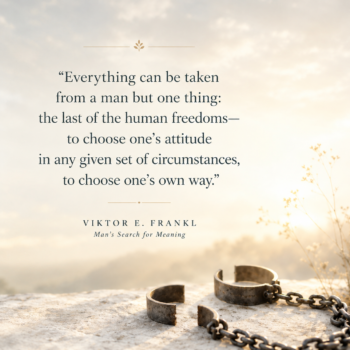
“We who lived in concentration camps can remember the men who walked through the huts comforting others, giving away their last piece of bread,” he wrote. “They may have been few in number, but they offer sufficient proof that everything can be taken from a man but one thing—the last of the human freedoms—to choose one’s attitude in any given set of circumstances, to choose one’s own way.”
Dr. Eger’s own therapy centered around many of the same ideas. She believed healing came not from denying suffering but from refusing to remain imprisoned by it—by choosing to find freedom through an inner journey using the tools of compassion, humor, optimism, curiosity, and self-expression.
Eger believed we are not meant to remain prisoners of our past. Again and again, she returned to the same liberating truths—that while pain is inevitable, suffering does not have to define us. That trauma, while terrible, can sometimes become a catalyst for growth rather than a permanent identity.
She taught that forgiveness is not about excusing cruelty but freeing ourselves from carrying bitterness forever. She urged people to challenge the limiting stories they tell themselves, to live more fully in the present moment, to find purpose even after heartbreak, and to treat themselves with compassion instead of shame.
Her approach resonates deeply with me. I’m sure this is why I was drawn to her story years ago. I recognized these were the very tools I had used to work my way through the grief of losing my youngest son. I also could see these had been modeled to me by my mother when I was still a teenager. Mom always managed to make lemonade out of lemons. She taught me the importance of choosing better over bitter.
When my mom’s marriage of 18 years ended, she faced some difficult choices. She was 36 and wanted to return to California and teach but had no college degree and two teenage daughters to care for. She enrolled at LSU in classes that would prepare her for teaching business subjects or prepare her for secretarial work if she needed to quit school. Five years later, I helped her pack up and move to California to teach in the Business Department at Cuesta Community College—a dream come true.
I would never suggest that anyone “chooses” tragedy or loss. Mom didn’t want a divorce. Neither did I. And no loving parent would choose to lose a child. Grief is real. The pain is real. There were days when simply answering the phone or getting through ordinary tasks felt difficult. But Frankl and Eger were both pointing to our one last freedom, the one that Edith’s mother whispered to her, “Remember, no one can ever take away what you have in your mind.”
We may not choose what happens to us, but we still have the freedom to choose what happens within us and how we respond. Our choices aren’t always grand triumphs. Sometimes just choosing to make your bed every day can make a difference. Admiral William McRaven makes this point in his book Make Your Bed: Little Things That Can Change Your Life…And Maybe the World.
McRaven, a retired Navy SEAL, wrote his book based on lessons learned during SEAL training. His message was surprisingly simple. Start your day with a completed task. Don’t expect life to be fair. Keep moving forward. Help others paddle. Face the sharks. And above all—never ring the bell. In SEAL training, ringing the bell meant quitting.
I’ve not trained to be a Navy Seal, nor have I ever been without a roof over my head, plenty of food to eat, and a warm bed to sleep in. McRaven chose his challenges. Eger and Frankl certainly didn’t choose their circumstances and neither did my mother. Nor did I. Yet all of us, in very different ways, refused to “ring the bell” and quit.
Because in real life, many of our circumstances are not chosen at all. We may face loss, divorce, illness, betrayal, financial upheaval, aging, loneliness, or the death of someone we love. Stuff happens. It just does.
Yet somewhere inside those realities remains the key to our freedom—our ability to choose our response. Not perfectly. Not all at once. Not without grief or pain.
Sometimes resilience is not dramatic at all. Sometimes it looks like getting out of bed, making the bed, answering the phone, going back to school, helping another person, or deciding to remain openhearted after life has given us every reason to close down.
We don’t want to deny grief, or sugar coat it with positivity and simply “rise above” suffering. But, we can participate in what we make it mean. That’s our power. That’s our key to resilience. That’s our choice.
Liberation of the Nazi concentration camps happened 81 years ago this month. Not many who survived these camps are still with us. May we also not lose the powerful lessons they left for us.