(Prefer to listen? Tap here)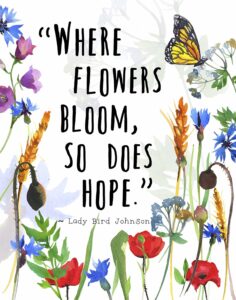
Planting Seeds of Hope
In a world that often feels heavy with what is being torn apart, today’s Cuppa Joy reflects on the importance of noticing what is still being tended, nurtured, and brought back to life.
This morning, I found myself browsing through my file of saved articles—the place where I tuck away ideas for future Cuppa Joys. It’s a bit like a garden of possibilities, where some ideas wait patiently and others call out at just the right moment.
Since Saturday was the first day of spring, I was drawn to a couple of articles I had saved—both rooted in the idea of planting and renewal. Here in Sacramento, we’ve had temperatures in the high 80s and low 90s for the past week. It feels more like the beginning of summer. I’ve lived here for almost 60 years, and this doesn’t feel like a normal spring. My son in Idaho tells me they’re noticing the same shift in their weather patterns.
Lately, the news has felt heavy—so much of it filled with what is being torn apart by conflict, by fear, by forces that leave us wondering what will remain. And I find myself, again and again, wanting to turn toward something else. Not to ignore what is happening, but to remember that alongside all that is breaking, there are also things being carefully and lovingly restored.
When I think of our planet—our precious Mother Earth—I hope we can learn to live in harmony with her needs as well as our own. You can probably guess that I align with the science that says climate change is real and that we have played a part in it.
Early or not, spring has sprung. Trees are budding and blooming, bulbs are popping, and weeds are plentiful in my flower beds—signaling a time for pulling and tending. I’m sure that’s why I wanted to share these stories with you. One is about a worn-out estate in England slowly being restored to life, and the other about neighbors right here in Sacramento gathering on a misty March morning to plant seeds in small community gardens—places thousands of miles apart yet connected.
The first story is about the Knepp Estate, a 3,500-acre property in southern England’s West Sussex. It was once worn-out farmland—overworked, depleted, struggling to produce. But instead of pushing harder, the owners made a different choice. They stepped back. They allowed the land to rest. And slowly, over time, life began to return. Wildflowers spread. Dragonflies returned. Endangered birds, including doves and nightingales, came back. The soil, once exhausted, began to heal.
It took over 20 years. Owners Isabella Tree and Charlie Burrell inherited the land in 1985. By 2000, they said, “We were finally realizing that no amount of intensification was going to make farming work on this land.” They began their rewilding project in 2001, starting with sowing native wildflowers, grasses, and seeds in the 350-acre parkland surrounding the estate house. They then introduced Tamworth pigs, Exmoor ponies, longhorn cattle, and red, roe, and fallow deer to the wider estate. Internal gates were removed to allow the animals to roam freely, spreading seeds and nutrients through their dung and fur.
Knepp Estate now has a glamping business, offering accommodation in cozy shepherd’s huts, yurts, and treehouses, along with safaris, guided walking tours, and rewilding workshops. Click here to learn more.
This transformation is the kind of story that always catches my attention—the kind I look for, the kind I write about. A story that reminds me to focus on the beauty and love that surrounds us, to pay attention to the joy that bubbles up in the midst of chaos.
As I was reading about this land coming back to life, I noticed a small editor’s note I had almost overlooked. It mentioned a series focused on both the environmental challenges facing our planet and the solutions—and that Rolex has partnered in that effort through something called the Perpetual Planet Initiative.
Rolex? Of all the things I expected to find linked to environmental restoration, a luxury watchmaker was not one of them. And I realized in that moment how little I actually knew about Rolex—beyond the idea of very expensive watches and a certain kind of status.
Curious, I followed the link and learned more. Rolex, it turns out, is not just about watches. Their timepieces are designed to last for generations—not replaced, but repaired, cared for, and passed down. And not just their watches are meant to be passed down—quietly, very quietly, they have also been investing in the future of the planet.
Through their philanthropic initiative, they support scientists, explorers, and conservationists working on long-term environmental restoration. Not quick fixes or headlines, but patient, often unseen work—restoring coral reefs, studying glaciers, protecting fragile ecosystems, and helping places like the Knepp Estate come back to life.
I love their success story. And there are also success stories closer to home. The other story I had tucked away described a misty Sunday morning in Oak Park, where volunteers were kneeling in the soil, planting tomatoes and peppers and squash—not just to feed themselves, but to feed a community. People choosing to gather in what one organizer called a “third space”—not home, not work, but a place to belong—a place to share knowledge, culture, food, and connection.
One garden coordinator spoke about growing food for families who don’t have the time or resources to grow their own. Another gardener talked about the simple pride of feeding your family something you have planted yourself. A physician brought his daughter to collect ladybugs among the flowers. A woman, now retired, described the garden as a source of solace and comfort—not just a plot of soil, but a shared box of vegetables and a conversation between neighbors.
We live in a world that moves quickly—where so much is built for convenience, for speed, for the now. It’s easy to feel the weight of that, especially when we think about our grandchildren and their children and the world they will inherit. I feel that sometimes—a quiet concern, a wondering about what will remain.
Stories like these keep me optimistic. In England, land once worn down is being given time to heal. Around the world, scientists and conservationists are quietly doing the long work of restoration.
And right here at home, in neighborhoods not far from where I sit, people are planting seeds—literally and figuratively—for one another. There is something deeply hopeful in that—not loud or dramatic, but steady.
It makes me think about the choices we each make—not in some grand, sweeping way, but in the small, daily ways we tend to what is right in front of us. Perhaps that is our own version of tending the planet.
Not all of us will restore thousands of acres of land. But each of us is given moments—small, ordinary, precious moments—where we can choose care over indifference, attention over distraction, gratitude over fear.
And those moments add up. They always have.
I invite you to join me in holding these promises of hope—of land once depleted, now slowly coming back to life. Of hands in the soil in Oak Park—and in community gardens wherever they are sprouting up. Of people working quietly, faithfully, for a future they can lovingly pass on.
I’m reminded again why I write these each week—to notice, to remember, to gently turn our attention back to what is still good, still growing, still possible. Because joy is always bubbling up—we just have to be willing to follow the light.
May you enjoy this spring weather and plant seeds of hope wherever you go.