
(Prefer to listen? Tap here)
Thin Places in the Veil
Some places feel sacred the moment you arrive—places where the unseen line between the ordinary and the divine grows so thin one almost expects to step through into another realm. The Celts had a name for them—thin places in the veil.
Some places feel magical the moment you arrive. Ireland was like that for me. I’ve traveled there twice, both times in May, and if someone handed me a ticket tomorrow, I would pack my bags without hesitation. I love almost everything Irish—perhaps with the exception of the legendary temper. The people are friendly and quick with a laugh, the countryside rolls out like a postcard in every shade of green imaginable, and the air itself seems filled with stories waiting to be told.
I didn’t know much about my own heritage until I took a DNA test a few years ago. The results showed that I’m about 65 percent British, Scottish, and Irish. Perhaps that explains the freckles I grew up with and the curls that have never quite behaved themselves. It might also explain why Ireland felt strangely familiar—as if some distant ancestral memory recognized the landscape.
During my visits we wandered through ancient stone circles and sacred sites that have been there for thousands of years. We stood on the Cliffs of Moher with the ocean wind whipping our jackets and hair in every direction. We ducked into warm pubs at the end of the day where laughter and music flowed as freely as the Guinness. We climbed the narrow spiral stone stairs of ancient castles and leaned backward to kiss the Blarney Stone—an act that would probably fail every modern health inspection.
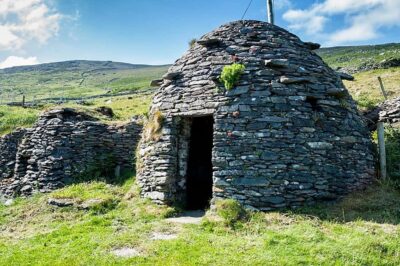
One of the most memorable stops came along the Dingle Peninsula. Our bus driver pulled over beside a quiet stretch of farmland where a scattering of small stone huts dotted the hillside. These were the ancient beehive huts built by early Christian monks—simple structures made entirely of stacked stone without mortar, where men once devoted their lives to prayer.
The land belonged to a local woman named Mary. Our driver stepped down from the bus and politely asked permission for us to wander among the huts for a few minutes. She graciously said yes.
I climbed carefully across the rocks and grass and stooped down to enter one of the low stone buildings. Inside, the walls curved inward until they met in a rounded peak above my head. The huts were simple—no decoration, no ornament—just stone placed carefully upon stone. Standing there quietly, taking in the moment, I could feel a presence. Centuries of prayer have a way of leaving a trace.
Ireland is full of places like this—thin places in the veil—where the unseen line between heaven and earth, or the physical and spiritual worlds, feels almost nonexistent and the veil becomes so sheer one almost expects to step through into another realm.
And that brings me to another of my favorite memories—something far less ancient and far less impressive to look at, but every bit as memorable. We were traveling along a highway in County Clare when our bus driver—who was a marvelous storyteller in his own right—began preparing us for what we were about to see. He told us to keep watching out the left side windows and not to blink or we might miss it.
Up ahead, he explained, stood one of Ireland’s famous fairy trees. Fairy trees, he told us, are not to be disturbed. Damaging these sacred trees is traditionally believed to bring severe misfortune—including disease, accidents, cursed land, and even death.
In Irish folklore, certain hawthorn trees are believed to be portals to the Otherworld—places where the veil between worlds grows thin. Fairy trees, especially lone hawthorns standing in fields, are said to serve as resting places or entry points for fairies traveling between the human world and their realm. These trees are carefully guarded by the wee folk. To cut one down, damage it, or even interfere with it was considered extremely unlucky—the sort of mistake that could bring misfortune not just to one person but to an entire community. Stories passed down through generations only reinforce this belief. No one wants to mess with the fairies. Not even modern road engineers.
Which created a rather awkward problem when workers began upgrading the highway between Limerick and Galway. Right in the path of the new highway stood one of those lone hawthorns. The practical solution was obvious—remove the tree and continue construction.
But locals said “no way.” The County Clare Council made it clear that the fairy tree was to be protected no matter the cost. The construction contract specified that the road could not come within five meters of the sacred tree, and a protective barrier would have to be built around it.
The result was a ten-year delay while engineers figured out how to design the road around the tree. And so today, if you drive the M18 between Limerick and Galway, the highway makes a wide sweeping curve around a rather scruffy hawthorn standing alone in the median while truckers, tourists, and commuters speed past at one hundred kilometers an hour.
Our driver slowed just enough for us to spot it as we passed. I had been expecting something grand—an ancient, majestic tree with sweeping branches and a mystical presence, perhaps something on the scale of Avatar’s mother tree.
Instead, there it was. A small, rather messy, trunkless bush—about the size of an overgrown azalea. REALLY! This was the famous tree?
And yet somehow, that made the story even better. I remember feeling a mix of delight, amusement, and a certain quiet admiration. In a world that often sweeps aside the old in the name of progress, Ireland had rerouted an entire highway to preserve the mystical—and keep the fairies happy.
Today is St. Patrick’s Day—a holiday that has grown far bigger in America than it ever was in Ireland. Leprechaun hats, bright green costumes, and the tradition of pinching people who forget to wear green are largely American inventions. In Ireland the celebration tends to be quieter, though no less joyful.
What both cultures share, however, is a love of a good proverb. The Irish have a gift for compressing wisdom into a single line or two that makes you smile and nod at the same time. For example:
A good beginning is half the work.
A friend’s eye is a good mirror.
You’ll never plough a field by turning it over in your mind.
The older the fiddle the sweeter the tune.
And one that feels particularly wise in a world that needs kindness: Wide is the door of the little cottage. It is often poor people who are most generous.
Wherever your roots may lie, today is a fine day to celebrate a little Irish spirit—to share a story, raise a glass with friends, and remember that a bit of the mystical is still needed in this world.
And so, I’ll leave you with a traditional Irish blessing.
May the road rise up to meet you,
May the wind be always at your back.
May the sun shine warm upon your face,
And the rain fall softly upon your fields.
And until we meet again,
May God hold you in the hollow of His hand.