
(Prefer to listen? Tap here)
Walking for Peace
What do nineteen Buddhist monks from a monastery in Fort Worth, Texas, have to teach us about peace? And is anyone listening? In this episode of Cuppa Joy, I reflect on the Walk for Peace—a long-distance pilgrimage led by Buddhist monks walking from Texas through the southern and eastern states toward Washington, D.C. Through quiet presence, simple teachings, crying babies, and a beloved peace dog named Aloka, the monks offer a lived reminder that peace is not an abstract idea, but a daily practice. It’s a gentle invitation to notice where peace is already walking among us—and how we might walk with it.
I’ve been asking friends—thoughtful, engaged people—whether they’ve heard about the monks’ Walk for Peace. Most haven’t. Even those who spend time on Facebook, where the monks’ journey has quietly gathered millions of followers, seem unaware that a long-distance pilgrimage for peace is unfolding right now across the Eastern United States.
The Walk for Peace is a long-distance pilgrimage initiated by Buddhist monks from their monastery in Fort Worth, Texas. I’ll admit, I didn’t even know there were Buddhist monks living in Texas. Somewhere in my imagination—and ignorance—they all lived in Tibet. And yet here they are, walking from Texas to Washington, D.C., carrying a message of peace, compassion, and nonviolence. God bless them. We sure need to be reminded of our better selves.
The walk began on October 26, 2025, and will span more than 2,300 miles in roughly 110 days. The monks are expected to arrive in Washington, D.C., around February 11 or 12, a few days earlier than planned. Walking alongside them is Aloka, a rescue dog who has become a beloved symbol of the journey.
There has been some national media coverage. CNN, in particular, has featured the monks several times, and NBC has aired a major Associated Press story. And yet the pilgrimage still feels oddly invisible. It hasn’t settled into our daily news diet or led the evening broadcasts. You could easily be an informed, engaged citizen and still have no idea that a growing movement for peace is unfolding on foot.
A march for peace doesn’t bleed, so it doesn’t lead. Chaos commands our attention; stillness rarely does. What the headlines miss, though, is happening. Day after day, the monks walk through small towns and along highways, in rain and snow. They stop to speak with people in school auditoriums and civic spaces. One monk was injured and lost a leg. And still they march. Another is quite old and dealing with pneumonia. And still they march.
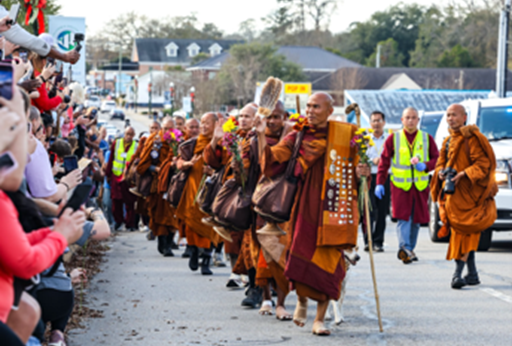
They rise before dawn and walk in silence. They stop before noon, where food is offered freely. Short teachings follow—on forgiveness, compassion, joy, and healing—never complicated, never shaming. Then they walk again until sundown. No evening meal. No excess.
The monks carry very little. Often their hands are open. Sometimes those hands hold flowers placed there by strangers. They carry a calm that draws people toward them without effort. They teach not through argument or dogma, but through simplicity—walk mindfully, eat well, sleep deeply, stay present, keep your heart clear.
What I’ve come to understand is that this walk is deeply grounded in the Buddhist teaching of the Four Noble Truths—suffering, its causes, the possibility of its end, and the path that leads there. The monks are not explaining these truths so much as embodying them.
They begin with the truth of suffering—not as an idea, but as lived reality. Walking day after day through heat, cold, rain, snow, and traffic, sometimes barefoot, they accept discomfort as part of being human. When one monk was struck by a vehicle and lost a leg, they did not frame it as a tragedy or a reason to stop. They acknowledged it as what is—an expression of impermanence—and they kept walking. In doing so, they hold not only their own suffering, but the collective unease of a nation living with uncertainty and fear.
They also speak to the causes of suffering, gently and without accusation. Again and again, they point inward—to agitation, impatience, and craving. Their extreme simplicity—one meal a day, few possessions, steady pace—becomes a living response to that restlessness. They are not rejecting the world; they are loosening their attachment to it.
What they demonstrate, perhaps most powerfully, is the possibility that suffering is not the end of the story. Peace is not a distant goal but a state that can be cultivated here and now. You can see it in the way they give away flowers, offer blessings, and share whatever is handed to them. Peace, when practiced, doesn’t diminish. It multiplies.
And finally, there is the path itself. The walk is the teaching. Step by step, breath by breath, they turn the road into a kind of moving meditation—right action, right speech, right mindfulness carried forward together. They speak often of choosing morality over violence, compassion over fear, and of treating all people as one family—not someday, not in theory, but right here on the road.
I’ve been able to catch some of their live teachings on Facebook. Watching a mindfulness talk in a school auditorium, I was struck by how clearly it revealed our shared human dilemma—how do we manage our attention? How do we stay present with what we want to focus on, rather than what pulls us away?
About 250 people were present. The monks were speaking gently about awareness—how to notice distractions and let them float by without clinging or resistance. And then, as life would have it, there were babies in the room. Two or three of them. Fussy. Crying. Doing what babies do. Their cries echoed throughout the space.
In the live comment stream, some viewers grew upset. The mothers should know better, they wrote. The babies were distracting. How could anyone concentrate on what the monks were saying with all that noise? And there it was—the teaching, unfolding in real time.
Watching that moment, I was struck by how often we believe peace will arrive once we manage the externals—quiet the noise, fix the problem, remove the inconvenience. Mindfulness asks something far more challenging and far more liberating—can we be with what is, without trying to change it? How do we live together in a world full of humans that is rarely quiet, rarely orderly, and seldom aligned with our preferences?
The monks were talking about mindfulness not as something we achieve by controlling our environment, but as something we cultivate within, even when the environment is imperfect. Especially then. The babies weren’t interruptions. They were the lesson. Peace, it turns out, does not require silence. It requires presence. The monks were unbothered. The babies cried. The room held both.
There may not be sustained national news coverage, but thousands of people are showing up to support the monks—more each day. They line sidewalks and courthouse steps. They gather in freezing temperatures and crowded school auditoriums. They sit quietly to learn mindfulness. They wait patiently for a blessing. They bring food, warm clothing, shoes, water, hot drinks, flowers, and handwritten notes. Something in our shared humanity recognizes something in these monks.
And then there is Aloka—the peace dog. Walking faithfully alongside the monks, padding through snow and slush, Aloka has somehow widened the circle of love even more. Children smile first at the dog, then look up at the monks. Adults soften. Strangers linger. Love, it turns out, often arrives on four legs.
What moves me most is not the number of followers on social media—though there are now millions—but the quiet truth beneath it: we are hungry for peace. Starving, really. And yet our daily news diet feeds us chaos, outrage, and fear, as if that were the only story worth telling.
This pilgrimage tells a different story. Not politics. Not protest. Not propaganda. Just peace practiced rather than proclaimed—mindfulness offered in school auditoriums, compassion embodied on asphalt and sidewalks, hearts touched one encounter at a time.
The monks are not trying to convince anyone of anything. They are simply walking. And in doing so, they remind us of something we already know but rarely see reflected back to us—peace is not an abstract idea or a distant hope. It is a daily choice. A way of moving through the world.
In their presentations, the monks often include a simple prayer focused on peace for all beings—the Metta Prayer, also known as the Loving Kindness Prayer. One common version goes like this—May all beings be happy. May all beings be safe. May all beings be at peace. May all beings be free from suffering.
What a beautiful reminder—and what a lovely call to answer.