
Prefer to listen? Click here.
What Love Can Do
I’ve been spending lots of time in my newly revamped sewing room. It still feels fresh to me. I’ve been making tote bags from old jeans, spreading fabric across the larger work surface, and losing track of time as I decide what might go where. I have space for cutting fabric and another place for sewing and pressing. It’s easy to find my groove, and I’m even learning a new way of stitching by hand.
But this week, while I’ve been enjoying that creative space, a close friend has spent yet another long day at the hospital with her husband. I find myself thinking about her as I work. Sometimes life feels like a merry-go-round. Other times, it feels like a roller coaster. I’ve been enjoying the gentle turn of my days while my friend has been thrown through one frightening turn after another. I’ve been feeling powerless when it comes to helping her.
When someone we love is going through a hard time, we often say, “I’m holding you in prayer.” I’ve said it, and I’ve meant it. Prayer gives me a way to hold someone close when I can’t be beside them. But I want my prayers to move me toward action, too. My friend needs sleep, answers, and relief for someone she loves. None of those things is mine to give. So I’m left asking what can I do.
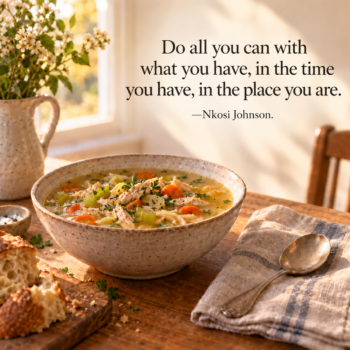
I can make soup. I can pick up groceries. I can let her know I’m nearby—just a phone call or text away. Those offerings feel terribly small when measured against what she’s facing. I made the soup anyway, remembering how much such seemingly small things mattered when Michael died.
In the first days after losing my son, I didn’t know what I needed. I was still trying to grasp what had happened, much less think about meals or decide what to ask of anyone. My home filled with family and friends. They didn’t wait for me to figure it out. They brought food. They cleaned my kitchen. They made phone calls. They took on the work of putting together Michael’s memorial service.
One friend arrived with an apple pie, still warm from the oven. She sat with me while we each had a piece. The most delicious pie ever. Another brought lasagna. Someone showed up with a complete turkey dinner, knowing my household had expanded with out-of-town family.
I remember sitting around my kitchen table sharing stories about Michael. We laughed and we cried. In those unraveled, new-reality days, I needed people who knew his name, remembered his life, and weren’t afraid to speak of him.
They couldn’t change what had happened or make sense of it for me. They saw things that needed doing and did them. They made room for me to just be. All of it was so beautifully helpful, especially because I could never have told them what to do. They carried me.
I’m not saying my friend needs a household full of people. What she needs most right now may be a good night’s sleep. Knowing her, she might feel she had to take care of everyone who came to help.
I’m beginning to notice that my urge to help has something to do with my own discomfort, too. It hurts to watch someone I love go through a frightening time. If I bring food or find an errand to run, I feel a little less helpless. But what eases my heart may not be what eases her day. I need to slow down long enough to find out what would make a difference for her.
As you know, I save stories. One I recently found was about Mary Jane Rathbun, known as “Brownie Mary.” She volunteered with people living with AIDS at San Francisco General Hospital. She baked marijuana brownies for patients struggling with nausea and appetite, bringing relief to people whose suffering she couldn’t take away.
Mary was a rebel with a cause. She risked arrest to care for her patients, then joined others advocating for medical marijuana. In 1996, California voters passed a law allowing its medical use. The account I first read was full of dramatic details, but what stayed with me was simpler. Mary paid attention to what the people in front of her needed and offered what she could.
Noticing what someone needs can lead to action, whether that action is a year-long campaign or a quiet errand for a friend. Mary’s story brings me back to my own friend. Before I decide what I can offer, I want to listen for what would make a difference to her.
Remembering what my friends did for me helps me see my own offerings differently. They took care of ordinary needs I couldn’t have named at the time. Neither soup nor a grocery trip will solve what my friend is facing, but either might make one exhausting day a little easier.
I’ve also thought about how hard it can be to receive help. I know how quickly I might say, “Oh, I’m fine,” because explaining what I need feels like one more task. An offer such as “I’m going to the grocery store this afternoon. Can I pick up something for you?” gives a person something simple to answer.
Back in my sewing room, the denim pieces wait where I left them. I’m learning Sashiko stitching, making small, repeated stitches across fabric. My hands have to slow down enough to see where the next stitch belongs. I’m still a beginner, and I sometimes pull the thread too tightly or lose the line I meant to follow.
I’ve had my turns on the roller coaster, too. Perhaps that’s why I value these quieter days and the time in my sewing room that restores me. I know how much it matters to have a place to rest between life’s hard stretches—and how much it matters when someone notices you’re in the middle of one.
I remember a warm apple pie, friends at my kitchen table, and the kindness I didn’t know how to ask for. I’ll keep praying for my friend and her husband. I’ll keep listening. And I’ll let love tell me what I can do. So far, that has meant making chicken soup and picking up ice cream, fudgsicles, yogurt, and prescriptions.
If this Cuppa Joy stirred something in you—a memory, a smile—I’d love to hear your thoughts in the comments below.