
Prefer to listen? Click here.
What the Boxes Miss
How much can a little checkmark in a box tell us about a person? We begin collecting them almost as soon as we enter school. Excellent, satisfactory, needs improvement. Somewhere along the way, we learn that some boxes are better than others, and we spend a good deal of our lives trying to earn the right checkmarks. Just ask anyone who’s ever sat through an employee performance review.
I recently came across a story that has stayed with me. An 8-year-old girl brought home her progress report. Nearly every box contained praise, except one. The teacher noted that she was easily distracted in large groups. Looking up through her smudged glasses, she quietly asked, “How am I doing, Mom?” Her mother knelt beside her and acknowledged that, yes, she did look around a lot. But she also noticed when another child was sitting alone and needed a friend. She noticed when the family dog wasn’t feeling well and told her mom. She saw Grandpa slowing down and waited for him. And whenever they crossed a bridge, she commented on the view.
Her mother helped her understand that what appeared to be a weakness might also be a gift. She wasn’t necessarily failing to pay attention. She was paying attention to things other people overlooked. I love that story, perhaps because I remember a similar experience with my son Michael in middle school. He worried that he wasn’t checking the right boxes, and we talked about how those boxes couldn’t measure the gifts that made him who he was. That conversation made a tremendous difference in his self-esteem.
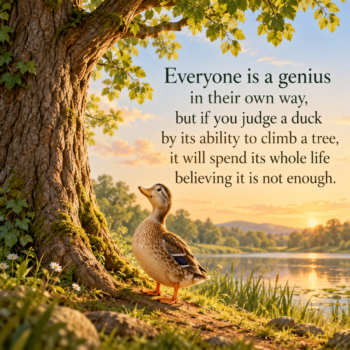
It reminds me of an old fable called The Animal School. The animals established a school where everyone had to study running, swimming, climbing, and flying. The duck was a magnificent swimmer but a miserable climber. To improve his climbing grade, he gave up swimming lessons and practiced until his webbed feet were so worn that he became only an average swimmer. The rabbit excelled at running but struggled with swimming. The squirrel was a wonderful climber but had trouble with flying. And the eagle was disciplined for reaching the top of a tree by flying instead of climbing.
The school set out to improve everyone’s weaknesses and nearly destroyed their strengths. I wonder how often we do something similar with people, concentrating on what they can’t do rather than appreciating what they bring. How often do we do it to ourselves?
One of my favorite television discoveries has been Patience, a British mystery series featuring a young autistic woman working in a police records department. Patience Evans has a remarkable ability to discern patterns and make connections others miss. When Detective Bea Metcalf recognizes her abilities, she invites Patience to help solve crimes. Ella Maisy Purvis, an actress who is herself autistic, brings her own lived experience to the role.
I’ve binged on the series, but not simply because I enjoy a good mystery. What I love most is watching Patience gradually find a place where she belongs. Her gifts don’t erase her difficulties, and her difficulties don’t diminish her gifts. Watching their relationship develop reminds me how one person’s kindness and acceptance can change another person’s life. Bea doesn’t need her to become someone else before appreciating her. Something similar happened behind the scenes. The producers recognized Ella’s talent and made accommodations so she could do her best work, rather than expecting her to adapt to every demand of the production. And how fitting that both the character and the series are named Patience. Perhaps that’s what we all need a little more of, especially when we—or someone else—don’t quite fit the expectations we’ve created.
At my book group this week, our conversation turned to how different the world looks to those of us in our seventies and eighties. We talked about the generation gap and how easily we can feel out of place in surroundings that seem ordinary to younger people. Imagine a group of us showing up at Harlow’s, a downtown Sacramento music venue, amid tattoos, piercings, and hairstyles that would have been considered outrageous when we were young. We’d certainly be aware that we were out of our familiar territory. Not necessarily unwelcome, but unmistakably different.
And then I thought about our parents. Remember the 1960s? Haight-Ashbury, hippies, long hair, bell-bottoms, beads, protest signs, and music that drove our parents crazy. Our generation challenged conventions that had seemed perfectly sensible to the people who raised us. We questioned authority, experimented with new ideas, and pushed against expectations about how we should dress, behave, and live. Our parents must have wondered what on earth was happening to the world. Now, sixty years later, perhaps we’re experiencing a little of what they did. We’ve lived long enough to watch the definition of normal change several times. It’s rather amusing to realize that we were once the young people who didn’t fit into our parents’ boxes. Now we sometimes find ourselves wondering about the boxes younger generations have created.
Differences can be amusing, interesting, even delightful. Noticing them is natural. It’s the judgments we attach to them that can get us into trouble.
Sometimes, though, unfamiliarity triggers something stronger than amusement or curiosity. We can feel uneasy, even threatened, among people who look or behave differently from those we’re accustomed to. Caution has its place. Walking alone on an unfamiliar street late at night isn’t the same as browsing in a bookstore or having dinner in a restaurant. Yet I wonder how often we confuse unfamiliar with unsafe. We can respect our instincts without assuming that everyone who seems different poses a threat.
Perhaps part of accepting differences is learning to recognize that distinction. We don’t have to ignore our instincts or force ourselves into situations that feel genuinely threatening. But we might give ourselves permission to be curious before deciding someone is a person to avoid. And when we’re the ones who are comfortable in a particular setting, perhaps we can extend that comfort to someone who isn’t. A smile, a little patience, a willingness to make room for another person’s way of being can communicate that they are welcome. Sometimes giving someone space, without expecting an explanation or a change in behavior, is its own form of kindness.
Growing older brings the benefit of experience, including the discovery that many things we once thought terribly important turned out not to matter very much. We’ve also learned that appearances seldom tell us the whole story. At least, I hope we’ve learned that. Yet I suspect we all continue to carry around invisible boxes. We have expectations about how children should behave, how adults should dress, how employees should work, and even how people our own age should live. Without intending to be unkind, we can make judgments based on what feels familiar to us.
I keep coming back to that little girl, looking up at her mother and wondering whether she’d disappointed her, just as my son Michael had looked at me for reassurance. Her mother didn’t pretend the teacher’s observation was wrong, nor did she suggest her daughter needed to change before she could earn her approval. She simply helped her see herself through more loving eyes. I remember Michael’s relief, and I can imagine the relief on that little girl’s face. I doubt we ever really outgrow the desire to have someone look at us and smile, accepting us just as we are.
If this Cuppa Joy stirred something in you—a memory, a smile—I’d love to hear your thoughts in the comments below.