Prefer to listen? Click here.
When Love Overflows
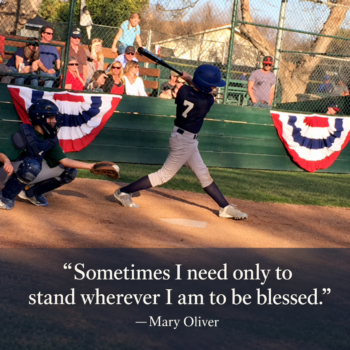
Eleven years ago, I sat in the bleachers at a Little League game watching my twin grandsons play. Their dad, my son John, stood behind the fence watching his boys. I don’t remember who won, whether either twin got a hit, or anything else about the game.
Nothing special had happened. It was one of many games and one of many afternoons spent sitting in the bleachers. Yet, for a moment, everything else seemed to fall away. What I remember is looking at the three of them and suddenly feeling overwhelmed by love. My heart felt too full to contain it. Happy tears filled my eyes. I can feel it even now.
I wasn’t trying to be grateful. I hadn’t reminded myself to count my blessings or appreciate the moment before it passed. The feeling came without warning. I didn’t create the love that was present that day. I simply recognized it. It was only two years after losing Michael, and my heart was still so, so tender.
Moments like this seem to occur more often lately. Something opens in me, and I become intensely aware of how much love surrounds me and how grateful I am for this particular life. One came just recently while I was walking Moxie. She was prancing along beside me, completely absorbed in a world I can barely imagine. Her nose led her from one fascinating smell to another while I kept tugging gently on the leash, intent on moving forward.
Moxie apparently believes a walk should be measured by the number of smells investigated. I tend to measure it by distance traveled. We do not always agree on the purpose of our outings.
On this particular walk, I found myself flooded with appreciation for our little routines, for the joy she brings me simply by being herself, and for the unmistakable ways she lets me know I am her person. Nothing about the walk was unusual. Moxie was doing what she always does, yet suddenly I saw the sweetness of this small life we share. She was completely present to her world, and for a moment, I became completely present to mine.
These experiences arrive unsummoned. I cannot seek them, chase them, wish for them, or make them happen. In fact, trying too hard seems almost certain to push them farther away. I can pause. I can pay attention. I can practice gratitude. But I cannot command my heart to burst open.
I’m sure that is why these moments feel so sacred. They are moments of recognition—brief openings in which I become aware of what has always been there, just waiting for me to notice.
Lately, I have also become more aware of missing my mother. A Facebook memory recently brought back one of our familiar rituals from the five years she lived with me. Mom completed many thousand-piece puzzles at my dining room table. Whenever she finished one, I took a photograph of her lifting the board on which the puzzle rested and raising a celebratory glass of wine.
We did it over and over. Another puzzle completed. Another glass raised. Another photograph taken. It was simply what we did. And the photograph was mandatory—Mom would not put the puzzle back in the box until we had taken it. The memory still makes me smile.
Now I look at those photographs and see more than a completed puzzle. I see my mother at my dining room table. I see the familiar pleasure she took in fitting all those tiny pieces together. I see our shared celebration and the ordinary intimacy of living under the same roof. And I see how much I miss her—her companionship, her cheering me on, her wisdom.
Pain backlights the presence of joy. The losses in my life remain losses. I miss watching the boys on the baseball field, Michael singing in the living room, and my house filled with family. After more than fifty years of attending church together, I still wish for one more Sunday sitting beside Mom.
Being grateful for the love in my life today does not keep me from missing what has changed or been lost. Sadness and love walk side by side. Loss hurts because the love mattered. I treasure those moments that remind me how deep that love still runs.
Recently, I read about an interview Maurice Sendak gave to Terry Gross on NPR’s Fresh Air. He was 83 and nearing the end of his life. Best known for writing and illustrating Where the Wild Things Are, he had endured the deaths of his longtime partner, his brother, and several close friends. As he spoke with Terry, he looked through his studio window at the old maple trees outside.
He said that as he aged, he was discovering that he was in love with the world. He could finally take the time to see the trees, read the books, and listen to the music. Although he cried for the people he had lost, he said, “I have nothing but praise now, really, for my life.”
Near the end of the interview, he described himself as “a happy old man” who would continue crying all the way to the grave. His voice was filled with emotion. As I read his words, my own eyes filled with tears, and I could imagine listeners pulling to the side of the road to swipe at theirs.
Sendak had discovered, as many of us have, that happiness and grief do not cancel each other out. He was happy, and he grieved. He praised his life, and he cried for the people who had left it. He didn’t have to stop missing them before he could recognize how deeply he loved the world. I could see myself reflected in his words.
Some moments are preserved in photographs and memories. But love continues to show up, dressed in new outfits, asking us to pay attention. For me, it arrives with family and friends, shared meals and card games, words written and received, bread baked to be given away, and gifts stitched one at a time in my delightful sewing room. Some of it prances beside me on a leash.
Perhaps growing older allows us to recognize happiness differently. It may not be the absence of pain or the presence of everything we once had. It may be the ability to look at the whole of our lives—the joy, the sorrow, the people who stayed, the people who left, and the ordinary days we were given—and feel praise rising within us.
We cannot make those moments of recognition happen. We cannot hold on to them when they come. But perhaps we can make ourselves more available to them. We can follow Ram Dass’s invitation to “Be Here Now”—pausing long enough to notice what gifts this moment holds.
The next time Moxie stops to investigate a smell that means nothing to me and everything to her, I may still tug on the leash. I do like to keep moving. But I can also give her another moment to explore while I look around at the life that is here and now.
Even when my heart is not bursting open with happy tears, love is still present—waiting to be recognized. Then come those moments when it can no longer be contained and simply overflows. I am forever grateful for those precious, unpredictable openings.